Contents
What is the Conversion of Binary Numbers to Decimal?
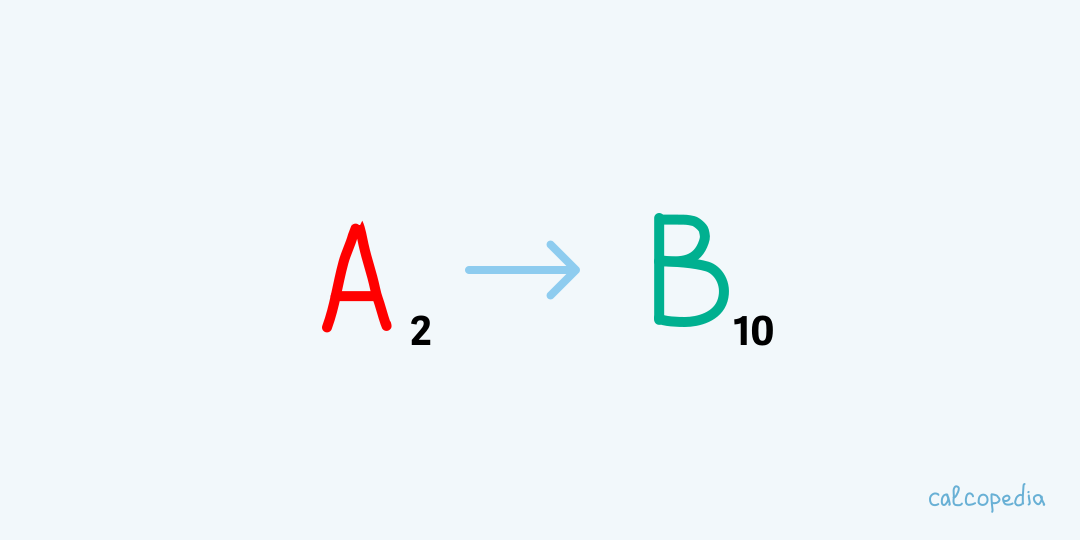
Converting a binary number to decimal involves translating a number from the binary system (base 2), which uses only two digits (0 and 1), to the decimal system (base 10), the most widely used numeral system.
The conversion is done by multiplying each digit of the binary number by the power of 2 corresponding to its position and then summing these values. For example, in binary 101, the decimal equivalent is 1*2^2 + 0*2^1 + 1*2^0 = 5.
This conversion is fundamental in computer science and digital electronics, where binary representation is a core concept.
How to Use the Binary to Decimal Conversion?
Understanding binary to decimal conversion is essential in various technological and computational fields.
Step 1: Enter the binary number into our online converter.
Step 2: The converter processes each binary digit according to its positional value.
Step 3: The result is a decimal representation of the binary number.
Examples of Binary to Decimal Conversion
Real-world applications of this conversion:
Example 1: Decoding binary code in computer programming into human-readable numbers.
Example 2: Converting binary outputs from electronic sensors into decimal for analysis.
Example 3: Understanding and troubleshooting digital circuit designs.
Nuances of Binary to Decimal Conversion
Key points to consider in this conversion:
- Accuracy is crucial, as a small error in conversion can lead to vastly different results.
- The understanding of binary and decimal systems is fundamental in computing and digital electronics.
Frequently Asked Questions
Why is binary to decimal conversion important in computing?
Binary to decimal conversion is essential because computers operate in binary, while humans interact with computers using decimal systems.
Can this converter be used for large binary numbers?
Yes, our converter is capable of handling large binary numbers, making it a versatile tool for various computational tasks.
How can understanding binary to decimal conversion benefit students in their studies?
Understanding binary to decimal conversion is beneficial for students, particularly in computer science and mathematics, as it deepens their understanding of numerical systems and computational logic.
Is the binary to decimal conversion relevant in everyday life outside of technical fields?
While primarily technical, binary to decimal conversion can be relevant in everyday life for understanding basic computing concepts and for enthusiasts exploring digital technologies.
Can this tool help in learning and teaching binary concepts in educational settings?
Absolutely, this tool can be an effective aid in teaching and learning binary concepts, helping students visualize and understand the conversion process between binary and decimal systems.
Similar calculators
You may find the following calculators on the same topic useful:
- Binary to Octal Calculator. Simple and quick conversion of binary numbers to octal format, suitable for computing and mathematical tasks.
- Binary to Hexadecimal Calculator. Quickly and accurately convert binary numbers to hexadecimal format for advanced computing and programming uses.
- Decimal to Binary Calculator. Efficiently convert decimal numbers to binary format, essential for computing and digital electronics.
- Decimal to Octal Calculator. Simple and accurate conversion of decimal numbers to octal format for diverse mathematical and computing applications.
- Decimal to Hexadecimal Calculator. Rapid and precise conversion of decimal numbers to hexadecimal format, suitable for advanced programming and IT tasks.
- Octal to Binary Calculator. Effortlessly convert octal numbers to binary format, an essential tool for computing and digital electronics.
- Octal to Decimal Calculator. Simple and quick conversion of octal numbers to decimal format, suitable for computing and mathematical tasks.
- Hexadecimal to Binary Calculator. Quickly and accurately convert hexadecimal numbers to binary format for advanced computing and programming uses.
- Hexadecimal to Decimal Calculator. Rapid and precise conversion of hexadecimal numbers to decimal format, suitable for advanced programming and IT tasks.
- Number System Conversion Calculator. Efficiently convert numbers between binary, decimal, octal, and hexadecimal systems for diverse mathematical and computing applications.
Share on social media
If you liked it, please share the calculator on your social media platforms. It`s easy for you and beneficial for the project`s promotion. Thank you!