Contents
What is the Conversion of Binary Numbers to Hexadecimal?
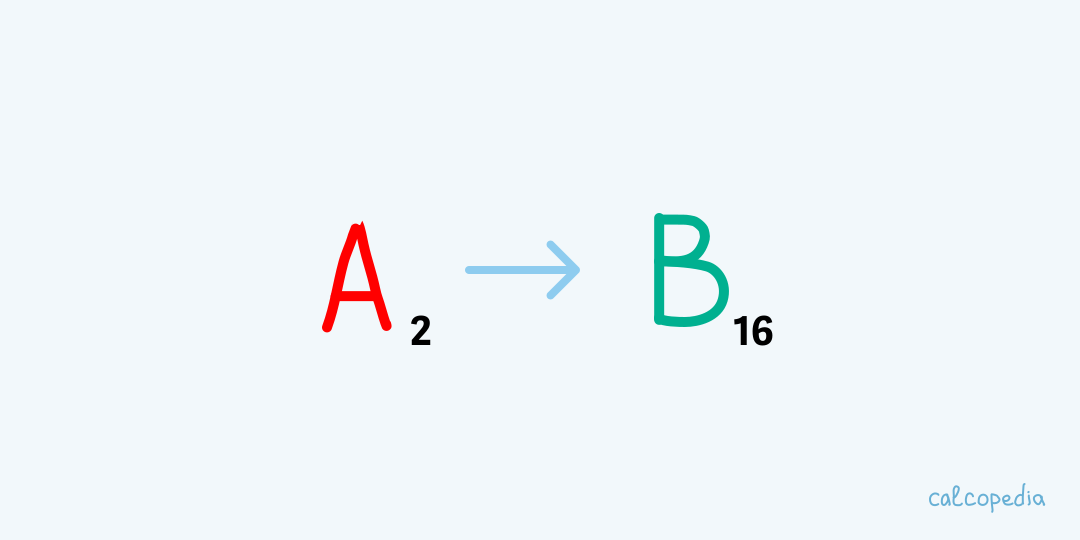
The conversion of binary numbers to hexadecimal involves translating numbers from the binary system (base 2) to the hexadecimal system (base 16). This process is essential in fields such as computer science and digital electronics.
Conversion is achieved by grouping binary digits in sets of four, starting from the right, and then replacing each group with the corresponding hexadecimal digit. For example, binary 1010 becomes A in hexadecimal.
This conversion is vital for simplifying binary representations and making them more readable and manageable in various technological applications.
How to Use the Binary to Hexadecimal Conversion?
Using binary to hexadecimal conversion is simple with our online calculator.
Step 1: Enter the binary number into the converter.
Step 2: The converter groups the binary digits and converts them to hexadecimal.
Step 3: The hexadecimal equivalent of the binary number is displayed as the output.
Examples of Binary to Hexadecimal Conversion
Real-world applications of binary to hexadecimal conversion:
Example 1: Simplifying complex binary codes in computer programming to hexadecimal for easier understanding and manipulation.
Example 2: Using hexadecimal representations in web design for color coding.
Example 3: Encoding binary data into hexadecimal in cryptographic algorithms and data security protocols.
Nuances of Binary to Hexadecimal Conversion
Important considerations for this conversion:
- Ensuring accuracy in the grouping of binary digits to avoid errors in the hexadecimal output.
- Understanding the correspondence between binary groupings and hexadecimal digits for correct conversions.
Frequently Asked Questions
Why is binary to hexadecimal conversion important in programming?
Binary to hexadecimal conversion is crucial in programming for simplifying and condensing binary data, making it easier to read, write, and debug code.
Can this converter be used for educational purposes in computer science courses?
Yes, this converter is an excellent tool for educational purposes, helping students understand and apply binary to hexadecimal conversion in practical scenarios.
How can binary to hexadecimal conversion aid in data storage and transmission?
Binary to hexadecimal conversion is useful in data storage and transmission as it allows for a more compact representation of binary data, making it easier to store and transmit large amounts of information efficiently.
Is there a practical application of this conversion for non-technical users?
Non-technical users may encounter binary to hexadecimal conversion in areas like setting up network configurations, where MAC addresses are represented in hexadecimal format.
Can mastering binary to hexadecimal conversion improve my skills in computer programming or data science?
Absolutely. Understanding binary to hexadecimal conversion is fundamental in computer programming and data science, as it enhances your ability to manipulate and understand binary data, which is a core concept in these fields.
Similar calculators
You may find the following calculators on the same topic useful:
- Decimal to Binary Calculator. Efficiently convert decimal numbers to binary format, essential for computing and digital electronics.
- Decimal to Octal Calculator. Simple and accurate conversion of decimal numbers to octal format for diverse mathematical and computing applications.
- Decimal to Hexadecimal Calculator. Rapid and precise conversion of decimal numbers to hexadecimal format, suitable for advanced programming and IT tasks.
- Octal to Binary Calculator. Effortlessly convert octal numbers to binary format, an essential tool for computing and digital electronics.
- Octal to Decimal Calculator. Simple and quick conversion of octal numbers to decimal format, suitable for computing and mathematical tasks.
- Hexadecimal to Binary Calculator. Quickly and accurately convert hexadecimal numbers to binary format for advanced computing and programming uses.
- Hexadecimal to Decimal Calculator. Rapid and precise conversion of hexadecimal numbers to decimal format, suitable for advanced programming and IT tasks.
- Number System Conversion Calculator. Efficiently convert numbers between binary, decimal, octal, and hexadecimal systems for diverse mathematical and computing applications.
- Gallons to Liters Volume Conversion Calculator. Effortlessly convert liquid volumes from gallons to liters for culinary, scientific, or general use.
- Liters to Gallons Volume Conversion Calculator. Accurately convert liquid volumes from liters to gallons for culinary, scientific, or everyday purposes.
Share on social media
If you liked it, please share the calculator on your social media platforms. It`s easy for you and beneficial for the project`s promotion. Thank you!