Contents
How the churn calculator works
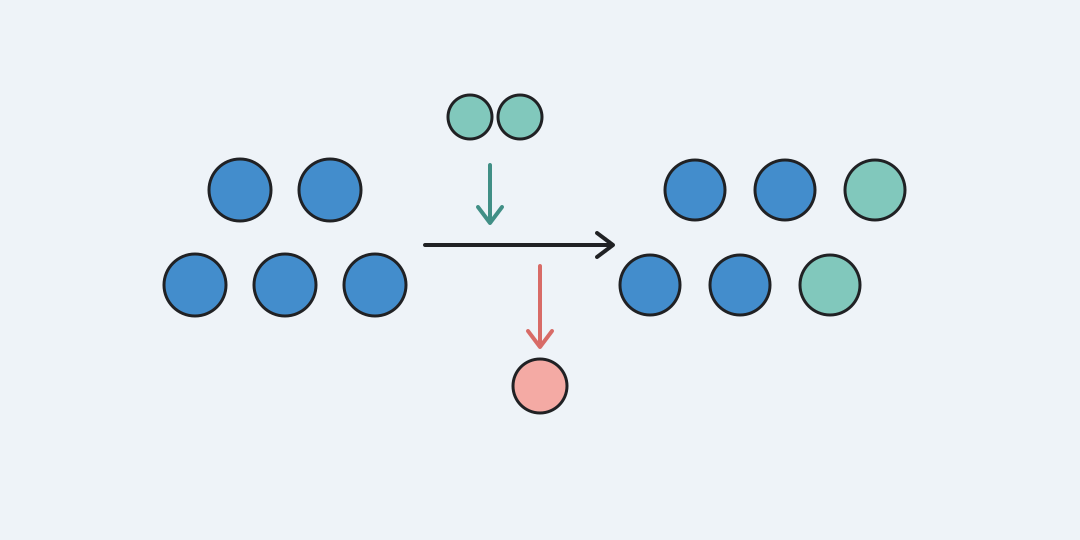
Churn rate measures what share of the starting customer base or recurring revenue was lost during a period. Select customers for gross customer churn or recurring revenue for net revenue churn.
Use one period and one definition
Enter the number at the start, the new customers acquired during the period, and the ending number. The calculator subtracts new customers from the ending total to estimate how many of the starting group remained.
Here is the starting count, new customers, and the ending count. This aggregate formula assumes that newly acquired customers did not also leave within the same period. If they did, use cohort-level events instead.
Revenue mode applies the same arithmetic to recurring revenue, but it measures a net change. Upsells and expansion among existing accounts can offset cancellations and downgrades, producing a negative net churn rate. All three amounts must use the same currency; no conversion is performed.
is starting recurring revenue, revenue from new accounts, and the ending total. This is not gross revenue churn, which requires separate loss data.
Three different stories behind the totals
Customers decline: start with 1,000, add 70, finish with 970. The estimated loss is 100; customer churn is 10%, retention 90%, and net customer growth -3%. Acquisition masked much of the loss.
Customers grow despite churn: 500 at the start, 100 new, 575 at the end. Twenty-five of the starting customers left, so churn is 5% even though the overall base grew 15%.
Expansion beats revenue loss: start with 2,000,000 in recurring revenue, add 200,000 from new accounts, and finish at 2,300,000. Net revenue churn is -5%; the starting accounts generate 5% more than before after all changes.
Do not compare unlike periods
A monthly 5% rate and an annual 5% rate describe different speeds of loss. Keep the period, active-customer definition and revenue basis consistent. A negative customer loss is rejected because it points to uncounted reactivations or incompatible totals; negative net revenue churn is valid.
Customer counts must be whole numbers up to 1,000,000,000. Revenue amounts may be decimal but cannot be negative; the starting value must be positive. Percentages are displayed to two decimals while the calculation uses the entered figures. Churn identifies the size of a loss, not why customers left.
Questions before acting on churn
The number is a starting point for investigation. Its usefulness depends on which customers and payments were counted.
Do new customers cancel out churn?
No. They can increase the ending base, but gross customer churn is measured against customers present at the start.
Why can net revenue churn be negative?
Expansion and upsells among existing accounts can exceed cancellations and downgrades.
Can I calculate churn weekly?
Yes, if weekly periods match your product and reporting. Compare it with other weekly periods, not an annual rate.
What if a newly acquired customer leaves immediately?
The three totals cannot separate that loss from churn in the starting cohort. Use customer-level events or a cohort report.
Is there a universally good churn rate?
No. Evaluate it against period length, customer segment, price model and your own trend.
Similar calculators
You may find the following calculators on the same topic useful:
- VAT Calculator. Determine the VAT amount from the price or calculate the VAT to be added.
- Online Income Tax Calculator. Calculate income tax online, based on the amount received 'in hand' or the total salary using different rates.
- Compound Interest Calculator. Discover how compound interest can boost your investments through reinvestment, scheduled contributions, and capitalization.
- Subtract Percentage from Number Calculator. Calculate online the subtraction of any percentage from any number using a special calculator.
- Add Percentage to Number Calculator. Add online any percentage to any number using a special calculator.
- Percentage Calculator. Calculate online the percentage of a number, by how much one number is greater or smaller than another in percentage, or what percentage one number is of another number. Also, add or subtract a percentage from a number.
- Percentage of a Number Calculator. Calculate online the value of a percentage of any number using this calculator.
- Amount in Words. Convert a numeric amount into text, suitable for drafting contracts and other official documents.
- Loan calculator. Compare fixed and declining repayment plans using neutral amounts that can represent any currency.
- Electricity cost calculator. Estimate energy use and cost from power and time or from measured kilowatt-hours.
Share on social media
If you liked it, please share the calculator on your social media platforms. It`s easy for you and beneficial for the project`s promotion. Thank you!