Contents
From appliance power to an estimated cost
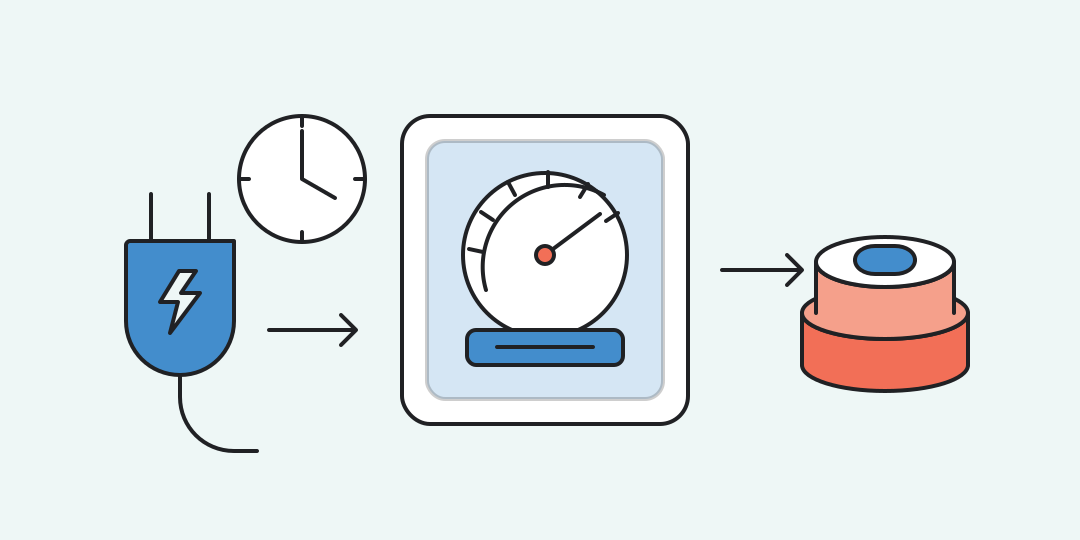
Enter an appliance's power and operating time, or use energy already measured in kilowatt-hours. The calculator multiplies each energy amount by its price and returns the estimated cost in the same currency as the rate you entered.
Choose the input that matches what you know
Power-and-time mode is useful before using or buying a device. Pick watts or kilowatts, enter daily operating hours and choose a period of 1 to 366 days. For a single tariff, energy use follows this model:
Here is energy in kWh, is power in kilowatts, is hours per day and is days. If power is entered in watts, the calculator divides it by 1000 first.
The measured-energy mode is better when a bill register, smart plug or meter already provides kWh. The distinction matters: watts and kilowatts measure power at a moment, while watt-hours and kilowatt-hours measure energy over time. The U.S. Energy Information Administration's guide to measuring electricity gives the same definitions and conversion.
Keep every tariff zone separate
With one rate, cost is simply energy multiplied by the price per kWh. With two or three zones, calculate each zone first and add the amounts:
is the energy assigned to a zone and is that zone's price per kWh. The effective average price is the total cost divided by total energy. Do not enter a provider's clock schedule from memory; use the zone names and rates printed on the bill, account or contract.
A 1 kW device running for 2 daytime hours and 1 nighttime hour on each of 30 days uses 60 kWh by day and 30 kWh by night. At rates of 7 and 3, the two parts cost 420 and 90, for a total of 510 in the tariff currency. The effective average price is 5.667 per kWh.
Three ways to check the estimate
A portable heater. A 1500 W heater running for 2 hours a day over 30 days uses 90 kWh. At a rate of 6.5 per kWh, the estimate is 585. A thermostat may reduce actual running time, so this is an upper-bound style estimate if the heater cycles off.
A measured monthly total. A smart plug reports 250 kWh. At 6.5 per kWh, the result is 1625. No wattage or operating-hour assumption is needed because energy has already been measured.
Three tariff zones. A 1000 W load runs one hour in peak, shoulder and night periods each day for 30 days. Every zone receives 30 kWh. At rates of 7, 5.5 and 3, the costs are 210, 165 and 90, giving 465 in total and an average of 5.167 per kWh.
Nothing used. Measured consumption of 0 kWh gives a cost of 0. Zero is valid in measured mode; a zero power rating is rejected because it does not describe an operating appliance.
Why the bill can still be different
Nameplate power can be a maximum rather than an average. Refrigerators, heaters, ovens, air conditioners and chargers cycle or vary their load. A meter measured over a typical period usually gives a better estimate for those devices.
The calculator includes only energy multiplied by the rates you provide. It does not add fixed charges, taxes, demand charges, tier thresholds, penalties, rebates, net metering or supplier-specific rounding. It also does not decide when a day, night, peak or shoulder period begins.
The watt is the SI unit of power and corresponds to one joule per second, as documented in the current BIPM SI Brochure. This unit relationship supports the energy arithmetic, but the result is not an electrical safety check. Cable size, current, protective devices and local electrical rules require a separate calculation.
Questions about electricity cost estimates
These answers clarify which input to use, how zones combine and what the final number does not include.
What is the difference between kW and kWh?
A kilowatt measures power. A kilowatt-hour measures energy: a 2 kW device running for half an hour uses 1 kWh.
Should I enter the maximum power from the label?
Use it for a cautious estimate when no measured average is available. Cycling or variable-load equipment often consumes less than maximum power over a full period.
Can I use any currency?
Yes. Enter every tariff rate in one currency. The cost and zone totals use that same currency, so no exchange rate is needed.
How do day and night tariffs combine?
Multiply daytime kWh by the daytime rate and nighttime kWh by the nighttime rate, then add the two costs. The calculator also reports the effective average price.
Can tariff-zone hours add up to more than 24?
No. Each value is daily operating time, so the visible zone hours together may not exceed 24.
Does the calculator reproduce my final bill?
No. It estimates the energy portion from your inputs. Fixed charges, taxes, thresholds, credits and provider rules are outside the calculation.
Similar calculators
You may find the following calculators on the same topic useful:
- Unit price comparison calculator. Enter two package prices and quantities to find which option costs less for the same amount.
- Discount calculator. Calculate a final price, saving, original price, or effective discount from the values you know.
- Break-even calculator. Enter a selling price, variable cost and fixed costs to find the first whole sale that covers the period.
- Loan comparison calculator. Enter two offers for the same amount to compare total cost, monthly outlay, and actual payoff time.
- Credit card payoff calculator. Enter the current balance, annual rate, fixed payment, and optional extra amount to estimate the payoff plan.
- Margin and markup calculator. Choose the two values you know to calculate profit, price, cost, margin and markup.
- Salary to hourly calculator. Enter your pay and work schedule to compare hourly, weekly, monthly, and annual amounts.
- Savings goal calculator. Enter your target and current savings to find the time needed or the monthly contribution for a fixed deadline.
- Simple interest calculator. Enter a principal, annual rate, and term to find the interest earned without compounding.
- Printer cost per page calculator. Enter cartridge price and yield, paper price, and page count to see the unit cost and total.
Share on social media
If you liked it, please share the calculator on your social media platforms. It`s easy for you and beneficial for the project`s promotion. Thank you!