Contents
Margin and markup measure different bases
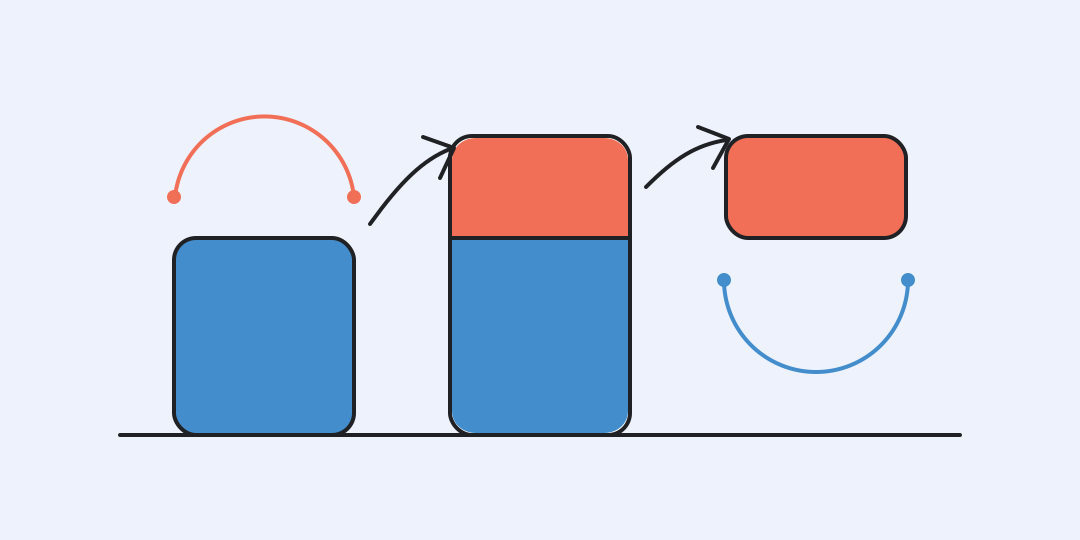
Margin compares profit with the selling price, while markup compares the same profit with cost. The calculator keeps those denominators separate and can solve the relationship from any supported pair of values.
Choose the pair you actually know
Select cost and selling price to inspect an existing offer. Select cost and markup to set a price. Select selling price and target margin to find the maximum cost that preserves that margin.
- Use one currency and the same unit, bundle, or accounting period for both amounts.
- Enter a margin below 100%; a 100% margin would leave no finite cost at a positive selling price.
- Treat the calculated profit as gross profit unless every relevant expense is already included in cost.
Three worked price decisions
Cost 600, selling price 1,000. Profit is 400. The margin is 40% because 400 is divided by 1,000; markup is 66.67% because 400 is divided by 600.
Cost 600 and markup 50%. The selling price is 900 and profit is 300. That price has a 33.33% margin, not a 50% margin.
Selling price 1,000 and target margin 40%. Cost may be 600, leaving profit of 400 and markup of 66.67%.
What belongs in cost changes the meaning
A result is only as broad as the cost entered. Purchase cost alone gives a product-level gross figure. Shipping, payment fees, labor, tax, returns, overhead, and discounts can change the real business result if they are not included.
A loss is valid input: cost 1,000 and selling price 800 gives a loss of 200, margin of -25%, and markup of -20%. When selling price is zero, margin is undefined; when cost is zero, markup is undefined.
Questions about margins and markups
The answers below clarify the denominator and the practical limits of the calculation.
Is margin the same as markup?
No. Margin divides profit by selling price, while markup divides profit by cost. They are equal only when profit is zero.
What markup gives a 40% margin?
A 40% margin corresponds to a 66.67% markup. For example, cost 600 becomes a selling price of 1,000.
Can markup exceed 100%?
Yes. A 100% markup doubles cost and produces a 50% margin. Markup has no 100% ceiling.
Why must margin be below 100%?
At a positive selling price, a 100% margin implies zero cost. Values above 100% would imply a negative cost in this model.
Does the result equal net profit?
Not necessarily. It is net profit only if the cost includes every expense relevant to the sale and period.
Which currency should I use?
Any currency or accounting unit works, provided cost and selling price use the same one. The calculator does not convert currencies.
Similar calculators
You may find the following calculators on the same topic useful:
- Salary to hourly calculator. Enter your pay and work schedule to compare hourly, weekly, monthly, and annual amounts.
- Savings goal calculator. Enter your target and current savings to find the time needed or the monthly contribution for a fixed deadline.
- Simple interest calculator. Enter a principal, annual rate, and term to find the interest earned without compounding.
- Printer cost per page calculator. Enter cartridge price and yield, paper price, and page count to see the unit cost and total.
- Churn rate calculator. Choose customers or recurring revenue and enter three values for the same period.
- VAT Calculator. Determine the VAT amount from the price or calculate the VAT to be added.
- Online Income Tax Calculator. Calculate income tax online, based on the amount received 'in hand' or the total salary using different rates.
- Compound Interest Calculator. Discover how compound interest can boost your investments through reinvestment, scheduled contributions, and capitalization.
- Subtract Percentage from Number Calculator. Calculate online the subtraction of any percentage from any number using a special calculator.
- Add Percentage to Number Calculator. Add online any percentage to any number using a special calculator.
Share on social media
If you liked it, please share the calculator on your social media platforms. It`s easy for you and beneficial for the project`s promotion. Thank you!