Contents
See what a fixed principal earns
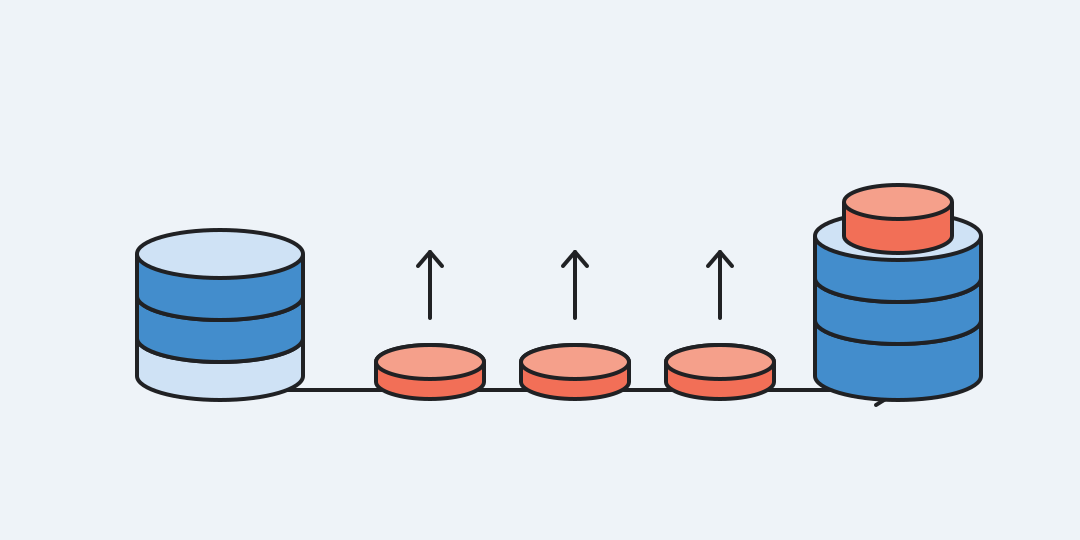
Enter an original amount, annual rate, and term. The calculator applies the rate only to the original amount, so each equal year contributes the same interest.
The simple-interest formula
P is the principal, r is the annual percentage rate, and t is time in years. The final amount is P + I. Months are divided by 12 and days by 365 before the formula is applied.
The large result is interest alone, not the balance you receive or owe at the end. The supporting row “Amount at the end” adds the principal back. “Interest over the full term” compares the interest with the unchanged principal.
Three calculations with different term units
Two years: 10,000 at 5% per year produces 10,000 × 0.05 × 2 = 1,000 in interest. The final amount is 11,000, and the full-term interest is 10% of principal.
Three months: 20,000 at 6% for 3 months uses 3/12 of a year. Interest is 300 and the final amount is 20,300. The example shows why a 6% annual rate becomes 1.5% over one quarter.
Forty-five days: 80,000 at 9.5% for 45 days gives about 936.99 using a 365-day year. The displayed total is 80,936.99; a contract using 360 days would differ.
Use the result as a transparent model
Simple interest assumes the principal and annual rate remain unchanged. It does not include compounding, deposits, withdrawals, instalments, fees, taxes, or rate changes. A typical amortising loan has a declining balance, so this calculator is not a repayment schedule.
No currency is selected. You can use dollars, euros, pesos, or another unit as long as the principal, interest, and final amount are interpreted in the same one. Results are rounded to at most two decimal places for display; the calculation is made before that rounding.
Questions about simple interest
What is the difference between simple and compound interest?
Simple interest is always calculated from the original principal. Compound interest adds earlier interest to the balance, so later interest can grow.
Should I enter 5 or 0.05 for a 5% annual rate?
Enter 5. The calculator divides the percentage by 100 inside the formula.
How are months converted?
A month is treated as one twelfth of a year, so 6 months equals 0.5 year.
How are days converted?
Days are divided by 365. Calendar dates, leap years, and contractual 360-day conventions are not modelled.
Can I use any currency?
Yes. The calculator has no fixed currency; keep every amount in the same currency or accounting unit.
Does it calculate loan instalments?
No. Regular repayments change the outstanding principal, while this model keeps it constant for the whole term.
Similar calculators
You may find the following calculators on the same topic useful:
- Printer cost per page calculator. Enter cartridge price and yield, paper price, and page count to see the unit cost and total.
- Churn rate calculator. Choose customers or recurring revenue and enter three values for the same period.
- VAT Calculator. Determine the VAT amount from the price or calculate the VAT to be added.
- Online Income Tax Calculator. Calculate income tax online, based on the amount received 'in hand' or the total salary using different rates.
- Compound Interest Calculator. Discover how compound interest can boost your investments through reinvestment, scheduled contributions, and capitalization.
- Subtract Percentage from Number Calculator. Calculate online the subtraction of any percentage from any number using a special calculator.
- Add Percentage to Number Calculator. Add online any percentage to any number using a special calculator.
- Percentage Calculator. Calculate online the percentage of a number, by how much one number is greater or smaller than another in percentage, or what percentage one number is of another number. Also, add or subtract a percentage from a number.
- Percentage of a Number Calculator. Calculate online the value of a percentage of any number using this calculator.
- Amount in Words. Convert a numeric amount into text, suitable for drafting contracts and other official documents.
Share on social media
If you liked it, please share the calculator on your social media platforms. It`s easy for you and beneficial for the project`s promotion. Thank you!