Contents
How the break-even calculator works
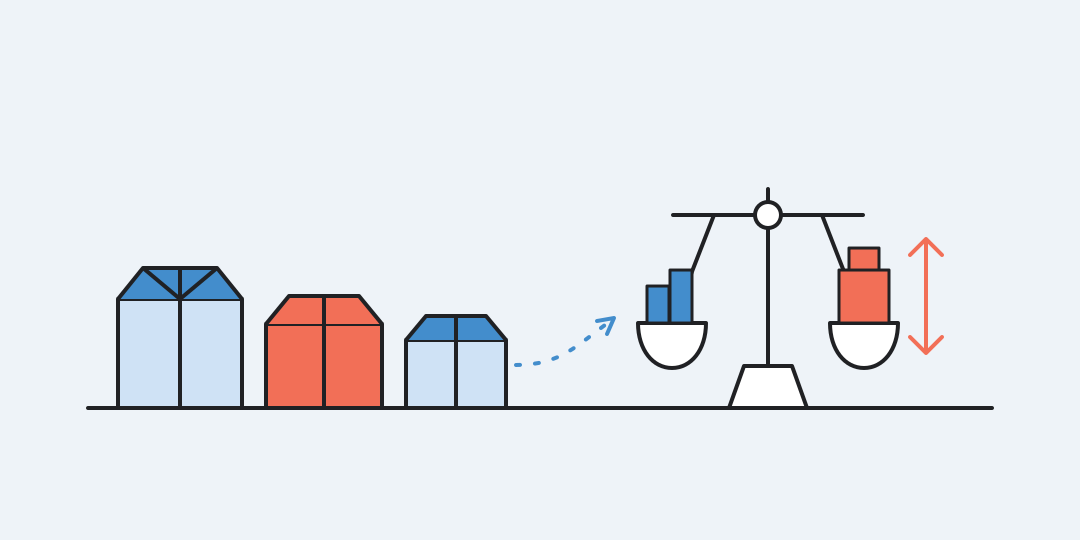
The calculator finds the first whole sale at which contribution from sales covers the fixed costs of one period. It also shows the exact threshold, revenue at the rounded target, contribution per unit and contribution margin.
Use one period and one sales unit
Enter the price and variable cost for the same unit, then add all fixed costs for one month, quarter or year. If fixed costs are monthly, read the result as a monthly sales target.
Each sale first contributes the difference between its price and its variable cost:
Divide fixed costs by that contribution to get the exact break-even quantity:
is price per unit, is variable cost per unit and is fixed cost for the period. The calculator rounds upward because a fraction of an ordinary item cannot complete the target.
Examples with different margins
Exact threshold. A product sells for 1500, costs 900 per unit and carries 300,000 in fixed monthly costs. Contribution is 600, so 300,000 / 600 = 500 sales. Revenue at that point is 750,000.
Fractional threshold. At a price of 2400, a variable cost of 1500 and fixed costs of 200,000, the formula gives 222.22 units. The practical target is 223 sales, producing 535,200 in revenue.
Thin margin. A price of 1000 and variable cost of 990 leave only 10 per sale. Fixed costs of 100,000 therefore require 10,000 sales. A small price-cost gap can make the target impractical.
Price cut. Reducing a price from 1500 to 1350 while variable cost stays at 900 lowers contribution from 600 to 450. With 300,000 of fixed costs, the target rises from 500 to 667 whole sales.
What the result includes and leaves out
Variable costs follow each sale: materials, packaging, payment fees or piecework. Fixed costs belong to the whole period: rent, fixed salaries, subscriptions and similar overhead. A fee charged as a percentage of sales usually belongs in variable cost.
The revenue shown is not profit. At the break-even point, contribution has just covered fixed costs. Taxes, returns, discounts and omitted expenses can move the real threshold.
The model assumes one constant price, one variable cost and one sales mix. For several products, use a stable weighted contribution or calculate separate scenarios. Also compare the target with demand and capacity. A correct result of 5000 orders is not actionable if the team can deliver only 2000.
Amounts may be dollars, euros, pesos or any other currency, but every money field must use the same one. Results display up to two decimal places while the formulas keep the unrounded values.
Questions about break-even analysis
These answers clarify rounding, cost categories and situations where a single-product model needs adjustment.
Why is the sales target rounded up?
If the exact result is 12.1 units, twelve sales do not fully cover fixed costs. The first whole target that does is 13.
What happens when price equals variable cost?
Contribution per unit is zero, so no finite number of sales can cover fixed costs. The calculator asks for a price above variable cost.
Can I calculate a yearly break-even point?
Yes. Enter yearly fixed costs and interpret the result as yearly sales. Keep price and variable cost on the same per-unit basis.
Where should a sales tax or marketplace fee go?
A charge that grows with each sale belongs in variable cost. A fixed account fee for the period belongs in fixed costs.
How do I handle several products?
Use a stable expected sales mix and its weighted contribution per sale, or calculate separate scenarios. A changing mix makes one threshold unreliable.
Is break-even revenue the same as payback?
No. Break-even balances operating income and costs for a period. Payback measures how long accumulated profit takes to recover an earlier investment.
Similar calculators
You may find the following calculators on the same topic useful:
- Loan comparison calculator. Enter two offers for the same amount to compare total cost, monthly outlay, and actual payoff time.
- Credit card payoff calculator. Enter the current balance, annual rate, fixed payment, and optional extra amount to estimate the payoff plan.
- Margin and markup calculator. Choose the two values you know to calculate profit, price, cost, margin and markup.
- Salary to hourly calculator. Enter your pay and work schedule to compare hourly, weekly, monthly, and annual amounts.
- Savings goal calculator. Enter your target and current savings to find the time needed or the monthly contribution for a fixed deadline.
- Simple interest calculator. Enter a principal, annual rate, and term to find the interest earned without compounding.
- Printer cost per page calculator. Enter cartridge price and yield, paper price, and page count to see the unit cost and total.
- Churn rate calculator. Choose customers or recurring revenue and enter three values for the same period.
- VAT Calculator. Determine the VAT amount from the price or calculate the VAT to be added.
- Online Income Tax Calculator. Calculate income tax online, based on the amount received 'in hand' or the total salary using different rates.
Share on social media
If you liked it, please share the calculator on your social media platforms. It`s easy for you and beneficial for the project`s promotion. Thank you!