Contents
How the sealant calculator works
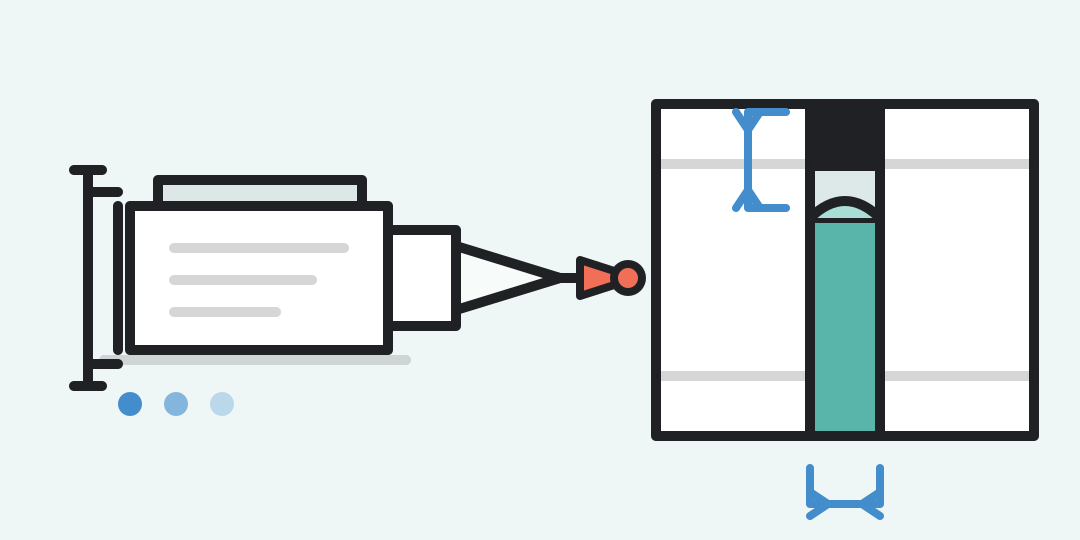
Enter the total joint length, its width and depth, the package volume and an allowance. The calculator returns the whole packages to buy and shows how much joint one package covers.
The volume comes from the joint cross-section
The calculator treats the filled joint as a long rectangular prism. It converts every measurement to compatible internal units before multiplying them.
L is total length, w is width, d is filled depth, r is the allowance percentage, and Vp is the volume in one cartridge, sausage or tube. The ceiling symbol means that a partial final package counts as a whole one.
Measure the filled space, not the visible smear
Add the lengths of every section that will receive the same product. Measure width across the gap. Depth is the actual thickness of sealant from the exposed surface to the backer rod or the bottom of the prepared joint.
If one section is much wider or deeper, calculate it separately. Averaging a 4 mm joint with a 12 mm joint can hide a large error because width and depth are multiplied, not added.
Three useful purchase checks
Bath edge. A 5 m joint measuring 6 × 6 mm contains 180 mL. With 10% allowance it needs 198 mL, so one 300 mL cartridge is enough and theoretically covers 8.33 m at that cross-section.
Wide construction joint. A 10 m joint measuring 10 × 10 mm needs exactly 1,000 mL before allowance. Four 300 mL cartridges are required because three provide only 900 mL.
US customary entry. A 20 ft joint measuring 0.25 × 0.25 in needs about 9.14 US fl oz with a 10% allowance. One 10 US fl oz package covers the calculated quantity.
Read the package count first
The large result is the purchasing answer. The required volume explains why the count rounded up, while coverage per package helps compare two package sizes for the same joint.
An allowance covers small variations, starts and stops, and material left in the nozzle. It cannot correct a wrong joint profile. For movement joints, wet areas or exterior work, follow the product data sheet for permitted dimensions, backing material, surface preparation and curing conditions.
Where the estimate stops
The geometry assumes a constant rectangular cross-section and full filling. Triangular beads, rounded fillets, interrupted application and deep voids need a different cross-sectional area. Porous edges and tool waste can also increase real consumption.
Questions before buying sealant
These answers cover the measurements that most often change the package count.
Should I measure the decorative bead width?
No. Enter the width of the filled gap. A bead spread over masking tape can look wider than the material actually occupying the joint.
How do I account for a backer rod?
Measure the sealant depth from the exposed surface to the rod. Do not subtract the rod as a separate volume.
Why does 3.01 packages become 4?
Packages are purchased whole. Three packages do not contain the calculated quantity, even when the shortage is small.
Can I combine several different joints?
Yes, if the same sealant is suitable. Calculate each cross-section separately, add the unrounded volumes, apply one allowance, then divide by package volume.
Does switching units change the answer?
No. The calculator converts metres, feet, millimetres, inches, millilitres and US fluid ounces to the same physical quantities.
Is the displayed coverage guaranteed?
It is a geometric estimate. Joint variation, waste, incomplete emptying and application technique can shorten actual coverage.
Similar calculators
You may find the following calculators on the same topic useful:
- Picket Calculator. Calculate the necessary amount of metal or wooden pickets for a fence online.
- Breakstone Calculator. Determine the weight or volume of crushed stone, converting between m³ and tons.
- Sand Calculator. Convert sand volume to weight and vice versa based on its type. A great solution for construction needs.
- Tonne Converter Calculator. Use this tool to convert different weight units, such as kilograms or grams, to tonnes.
- Box Volume Calculator. Use the calculator to determine the volume of a box in m³ or liters, considering its dimensions.
- Tube Volume Calculator. Determine the volume of a tube in cubic meters or liters by simply entering the diameter and length of the pipeline.
- Strip Foundation Concrete Calculator. Determine the required volume of concrete mix for effective pouring of a strip foundation.
- Slab Foundation Concrete Calculator. Get precise calculations for pouring a slab foundation to ensure the stability and durability of your building.
- Cubic Board Calculator. With our calculator, you can easily and accurately determine how many boards are required for your wooden house or other construction project.
- Online Laminate Flooring Calculator. Provide your room dimensions, and we'll help you calculate the ideal amount of laminate or parquet flooring without any leftovers.
Share on social media
If you liked it, please share the calculator on your social media platforms. It`s easy for you and beneficial for the project`s promotion. Thank you!