Contents
Show one volume in another unit
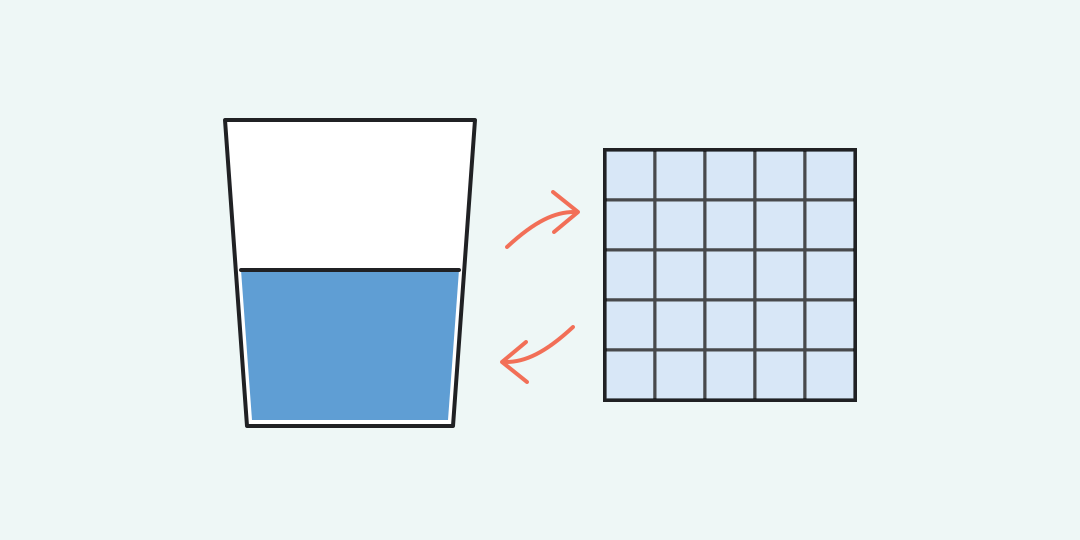
Enter a volume in either field, then choose two units. The paired value updates at once, with separate choices for metric, US liquid, and imperial measures.
The litre is the common bridge
Every listed unit has a factor that states how many litres it contains. The converter multiplies by the source factor and divides by the target factor.
For example, a US liquid gallon contains exactly 3.785411784 L, while an imperial gallon contains exactly 4.54609 L. The names are similar, but the sizes are not. US factors follow the NIST volume table.
Three useful checks
A drink bottle: 1.5 L equals 1,500 mL. This metric conversion moves the decimal point without introducing an approximation.
A tank drawing: 2 m³ equals 2,000 L. The converter changes the unit, not the physical amount the tank can hold.
A US specification: 10 US liquid gallons equal 37.854118 L. Choosing imperial gallons instead would produce 45.4609 L, so the unit system belongs in the result.
Volume is not mass
A litre of water and a litre of oil have the same volume but different masses. Converting litres to kilograms requires the material's density, so this tool does not guess it.
The interface shows up to six decimal places and switches to scientific notation for extreme values. That keeps a tiny nonzero result visible, but it does not add accuracy to the original measurement. The barrel option is the US oil barrel of exactly 42 US liquid gallons.
Questions about volume conversion
The safest conversion keeps the number, unit name, and measurement system together.
Is one litre the same as one cubic decimetre?
Yes. One litre equals exactly one cubic decimetre, and one millilitre equals one cubic centimetre.
Are US and imperial gallons equal?
No. A US liquid gallon is 3.785411784 litres, while an imperial gallon is 4.54609 litres.
Can I convert litres to kilograms here?
No. That conversion also needs the material's density, which is not determined by volume alone.
Can I type in the converted field?
Yes. Both fields are editable, and the field changed most recently becomes the source value.
Why does a result use scientific notation?
A very small or very large value is shown that way so a nonzero quantity is not rounded away or displayed as an unwieldy line of digits.
Similar calculators
You may find the following calculators on the same topic useful:
- TV screen size calculator. Enter a screen diagonal and aspect ratio to find its visible width and height, or calculate inches from two measured sides.
- Circle Area Calculator. Calculate the area of a circle online based on the diameter, radius, or circumference.
- Circle Diameter Calculator. Calculate the diameter of a circle based on the circumference, radius, or area of the circle.
- Circumference Calculator. Calculate the perimeter of a circle based on one known value: diameter, radius, or area of the circle.
- Parallelepiped Volume. Calculate the volume of any parallelepiped online based on the lengths of its edges and more.
- Sphere Volume Calculator. Calculate the online volume of any spherical object based on its radius or diameter.
- Triangle Area Calculator. Determine the area of a triangle online using different methods (angles, sides, height).
- Cylinder Volume Calculator. Determine the volume of cylindrical shapes: from pipes to cans in different units of measurement.
- Cone Volume Calculator. Calculate the volume of various conical forms in cubic meters or liters.
- Truncated Pyramid Volume Calculator. Determine the volume of a truncated pyramid based on its height and base areas.
Share on social media
If you liked it, please share the calculator on your social media platforms. It`s easy for you and beneficial for the project`s promotion. Thank you!