Contents
How the atmosphere-to-kilopascal converter works
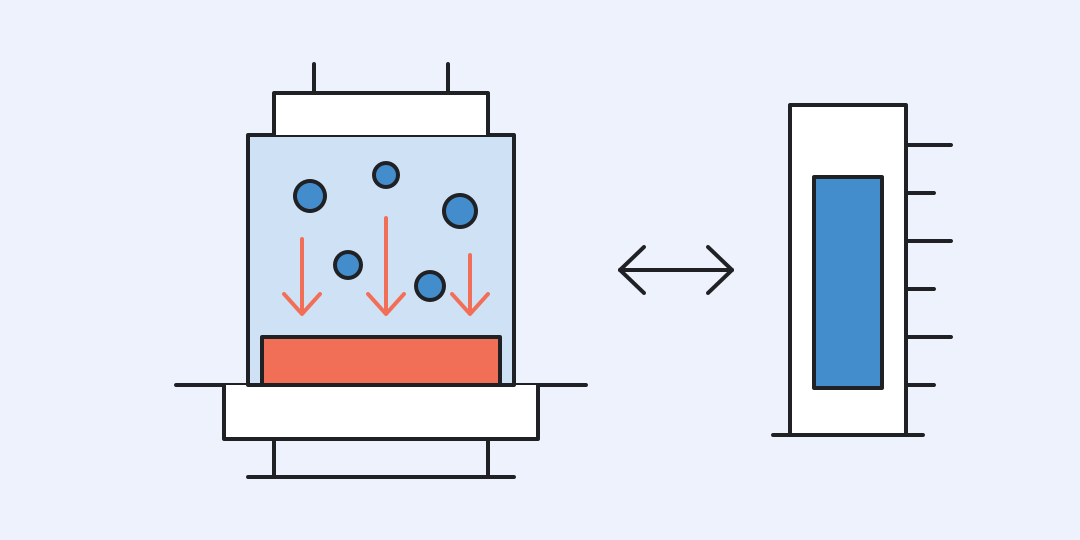
Type a pressure in standard atmospheres or kilopascals. The other field updates immediately, and the centre button reverses the direction without changing the pressure.
The fixed relationship between atm and kPa
The standard atmosphere, written atm, is defined as exactly 101,325 pascals. Since one kilopascal contains 1,000 pascals, one atmosphere is exactly 101.325 kPa.
No correction for altitude, temperature or humidity belongs in this unit conversion. Those conditions may change a real pressure reading, but not the size of either unit.
Reference values worth remembering
0.5 atm equals 50.6625 kPa. Half an atmosphere is simply half of 101.325 kPa.
2 atm equals 202.65 kPa. Multiply 2 by the fixed factor 101.325.
200 kPa equals about 1.973846533432 atm. For the reverse direction, divide the kilopascal value by 101.325.
Standard atmosphere is a unit, not today’s weather
Local air pressure rises and falls with weather and altitude. A reading of 98 kPa is still converted by the same factor; it is not silently treated as one atmosphere. The symbol atm names the fixed standard-atmosphere unit.
Do not confuse standard atmosphere, atm, with technical atmosphere, at. One technical atmosphere equals 98.0665 kPa, so the two units differ by more than three percent.
Keep the original measurement precision
An exact conversion factor cannot improve an approximate measurement. If a gauge reports 1.0 atm, a long converted decimal would imply accuracy that the source did not provide. Keep only the digits justified by the instrument or data table.
The form accepts zero and positive pressure magnitudes. It does not infer whether a value is absolute pressure or gauge pressure; retain that reference when comparing results.
Questions about atmospheres and kilopascals
Most mistakes come from confusing a defined unit with changing atmospheric conditions.
How many kilopascals are in one atmosphere?
Exactly 101.325 kPa are in 1 standard atmosphere.
How do I convert kPa to atm?
Divide the kilopascal value by 101.325. For example, 202.65 kPa equals 2 atm.
Is 100 kPa the same as 1 atm?
No. 100 kPa is approximately 0.986923 atm; 1 atm is exactly 101.325 kPa.
Does altitude change the conversion factor?
No. Altitude changes actual air pressure, not the fixed relationship between atm and kPa.
Are atm and technical atmosphere the same unit?
No. Standard atmosphere uses the symbol atm and equals 101.325 kPa. Technical atmosphere uses at and equals 98.0665 kPa.
Similar calculators
You may find the following calculators on the same topic useful:
- Metric horsepower to kilowatts converter. Enter power in metric horsepower or kilowatts and get the equivalent value immediately.
- Liters to milliliters converter. Enter a volume in liters or milliliters and see the equivalent value immediately.
- Capacitor energy calculator. Enter capacitance and voltage to calculate ideal stored energy, charge, millijoules and watt-hours.
- Voltage divider calculator. Enter the source voltage and two resistor values to calculate the unloaded output and circuit current.
- Water mixing temperature calculator. Enter two water volumes and temperatures to estimate the ideal mixture temperature and proportions.
- Density calculator. Choose the unknown quantity, enter two measurements, and get density, mass, or volume in the unit you need.
- Kilojoules to kilocalories converter. Enter an energy value in kJ or kcal and see the equivalent amount immediately.
- Miles per hour to kilometres per hour converter. Enter a speed in mph or km/h and see the equivalent value immediately.
- Microfarads to nanofarads converter. Enter capacitance in µF or nF and see the equivalent value immediately.
- Joules to kilowatt-hours converter. Enter energy in joules or kilowatt-hours and see the equivalent value immediately.
Share on social media
If you liked it, please share the calculator on your social media platforms. It`s easy for you and beneficial for the project`s promotion. Thank you!