Contents
How the capacitance converter works
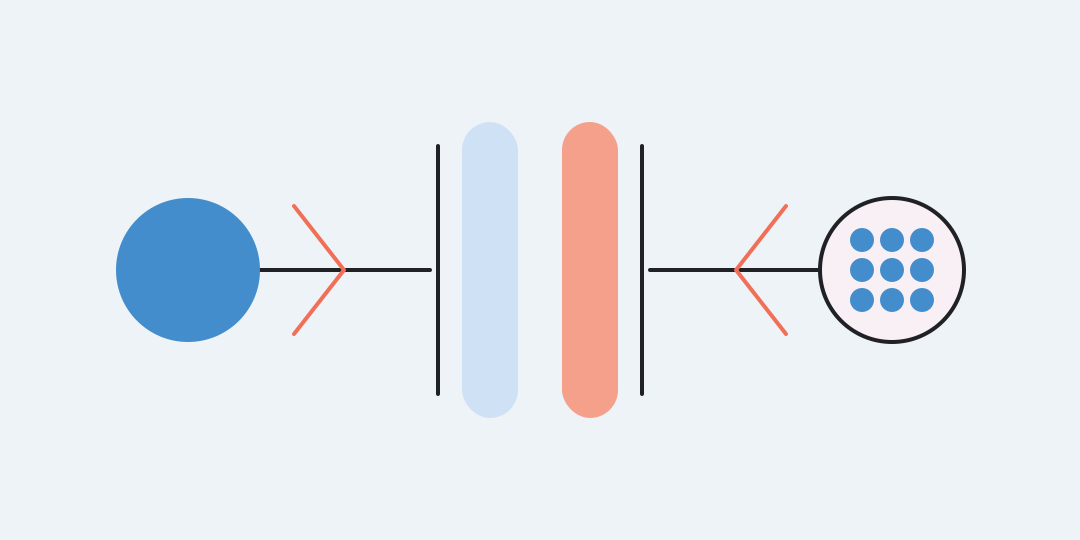
Enter capacitance in microfarads or nanofarads. The other field updates immediately, and the middle control reverses the direction without changing the electrical capacitance.
A difference of three SI-prefix steps
Micro means 10−6 and nano means 10−9 of a farad. Their exponents differ by three, so one microfarad contains exactly one thousand nanofarads.
Multiply µF by 1000 to get nF. Divide nF by 1000 for the reverse conversion.
Values found on common circuit documents
- 0.001 µF = 1 nF. Both markings describe the same capacitance.
- 0.1 µF = 100 nF. This is a familiar decoupling-capacitor value.
- 4.7 µF = 4,700 nF. The larger number comes from using the smaller unit.
- 2,200 nF = 2.2 µF. Divide by 1000 when reading the conversion backwards.
What the converted number does not tell you
Conversion changes only the unit. It does not determine a capacitor's voltage rating, tolerance, dielectric, polarity, temperature behaviour or package. Check those properties before replacing a component.
The factor is exact, but it cannot improve the precision of a rounded measurement or a component value with a tolerance. Keep the source unit next to the converted value when copying data into a schematic or bill of materials.
Questions about µF and nF
These answers cover the conversion factor, notation and the limits of comparing capacitor values.
How many nanofarads are in one microfarad?
Exactly 1000 nanofarads.
How do I convert microfarads to nanofarads?
Multiply the number of microfarads by 1000.
How do I convert nanofarads to microfarads?
Divide the number of nanofarads by 1000.
Are µF and uF the same unit?
uF is a common plain-text substitute for µF. Both usually mean microfarads, but the SI symbol uses µ.
Can equal capacitance values guarantee interchangeable capacitors?
No. Voltage rating, tolerance, dielectric, polarity and package must also suit the circuit.
Similar calculators
You may find the following calculators on the same topic useful:
- Joules to kilowatt-hours converter. Enter energy in joules or kilowatt-hours and see the equivalent value immediately.
- Watts to kilowatts converter. Enter power in watts or kilowatts and see the equivalent value immediately.
- Kilograms to grams converter. Enter a mass in kilograms or grams and see the equivalent value immediately.
- Days to hours converter. Enter a duration in days or hours and see the equivalent value immediately.
- Hours to minutes converter. Enter a duration in hours or minutes and see the equivalent value immediately.
- Minutes to seconds converter. Enter a duration in minutes or seconds and see the equivalent value immediately.
- Milliseconds to seconds converter. Enter milliseconds or seconds and see the equivalent duration immediately.
- Seconds to hours converter. Enter seconds or hours and see the equivalent duration immediately.
- Milligrams to grams converter. Enter a mass in milligrams or grams and see the equivalent value immediately.
- Micrograms to milligrams converter. Enter a mass in micrograms or milligrams and see the equivalent value immediately.
Share on social media
If you liked it, please share the calculator on your social media platforms. It`s easy for you and beneficial for the project`s promotion. Thank you!