Contents
How the recipe cost calculator works
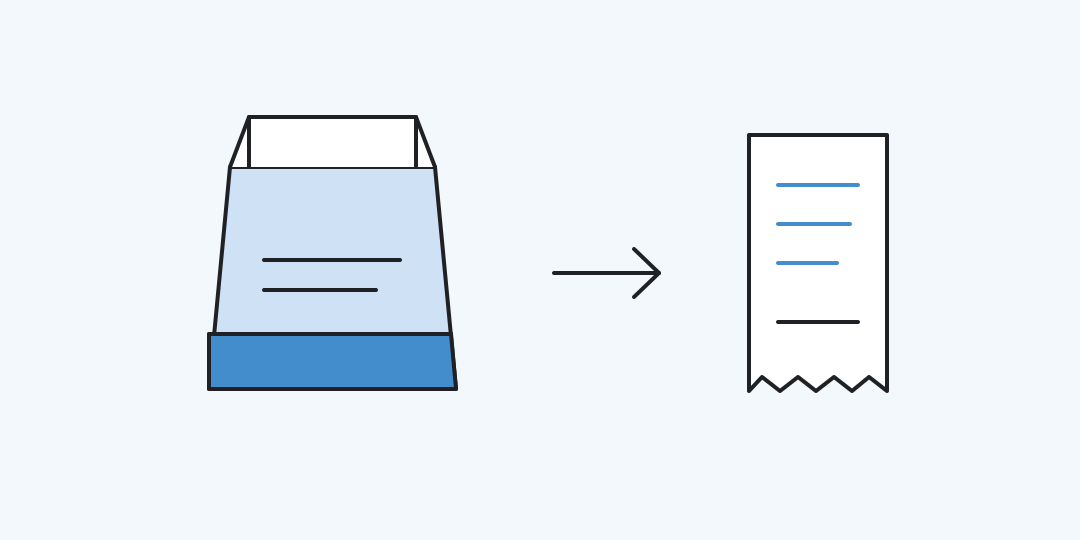
The calculator prices only the amount of each ingredient used in your recipe. It adds those amounts for the whole batch and divides the total by the number of servings.
Price the portion of the package, not the whole purchase
For each ingredient, enter what the entire package cost, how much it contains and how much the recipe uses. The ingredient cost is package price multiplied by used quantity divided by package quantity. The two quantities are converted to the same unit before division. Add all ingredient costs, then divide by the actual number of servings.
The unit selector reads from package to recipe. Choose kg → g when the bag is sold in kilograms and the recipe lists grams. Mass choices include g, kg, oz and lb; volume choices include mL, L, US fl oz and US cup. Pieces are counted separately. The calculator does not guess a density to convert grams into millilitres.
What the numbers mean at the stove
- A bag of flour costs 180 for 2 kg, and you use 500 g: its share costs 45. Sugar costs 120 per 1 kg and you use 200 g: add 24. Three eggs from a 10-egg pack priced at 120 add 36. The batch costs 105 in ingredients, or 17.50 per serving when it makes six equal servings.
- A 1000 g bag of grain costs 250. Using 160 g costs 40. If the pot serves four, that ingredient contributes 10 per serving before milk or toppings.
- Oil costs 360 for 2 L and the dressing uses 75 mL. Select L → mL: the used oil costs 13.50. Its weight is irrelevant because both amounts are volumes.
Read the total as an ingredient cost
Use one currency for every package price. The form does not convert currencies or apply a currency's smallest denomination. It keeps each line unrounded while adding, then displays up to two decimal places. The expandable breakdown shows which ingredient contributes most.
A fully empty added row is ignored. A partly filled row waits for the missing information instead of treating it as zero. You can enter a free ingredient at price 0 or an unused ingredient with used amount 0. The form accepts up to 30 rows and a whole-number serving count.
The total excludes labour, energy, packaging, delivery, waste and profit unless you represent a cost with a suitable row. For a selling price, add those expenses separately before using a margin calculation. If the finished recipe yields fewer servings than planned, update the serving count.
Questions that change the cost
Package size, actual yield and the price paid all affect the share assigned to a recipe.
Which price should I use after a discount?
Enter the amount actually paid for the entire package. The calculation assigns the same discounted price to the portion used.
How do I handle peels or bones?
If you know the usable yield, enter that usable amount as the package quantity. For example, 1 kg bought but 700 g usable means dividing the paid price by 700 g.
Can I mix grams and millilitres?
No. Converting mass to volume needs the specific ingredient's density. Weigh the used amount or keep both quantities as volumes.
What if I paid for several identical packs?
Add their quantities and enter the total price. Three 400 g packs become a 1200 g package with the combined price.
Is this the price I should charge customers?
No. This is an ingredient cost. A selling price also needs labour, overhead, packaging, waste and your desired profit.
Similar calculators
You may find the following calculators on the same topic useful:
- Barbecue Calculator. Calculate online how much meat is needed for a barbecue per person to ensure there's enough for everyone.
- Calculate Daily Protein Needs. Determine your daily protein intake based on your personal information and activity level.
- Calories and Macronutrients Calculator. Use the Calories and Macronutrients Calculator to determine your daily requirements for calories, protein, fat, and carbohydrates, for weight control and management.
- Online Calculator: Grams to Spoons. Simplify your culinary preparation by converting grams to spoons or vice versa.
- Calories per serving calculator. Enter the label value and your serving size to calculate its calories, or find how many grams or millilitres match a calorie target.
- Recipe scaler calculator. Enter the original and desired servings to scale every ingredient in the recipe.
- Coffee to water ratio calculator. Choose a brewing method and calculate the missing coffee, liquid, or ratio value.
- Churn rate calculator. Choose customers or recurring revenue and enter three values for the same period.
- VAT Calculator. Determine the VAT amount from the price or calculate the VAT to be added.
- Alcohol Calculator. Calculate the exact rate at which alcohol is eliminated from the body (in blood and breath): how long before a driver can get behind the wheel.
Share on social media
If you liked it, please share the calculator on your social media platforms. It`s easy for you and beneficial for the project`s promotion. Thank you!