Contents
How the water-heating calculator works
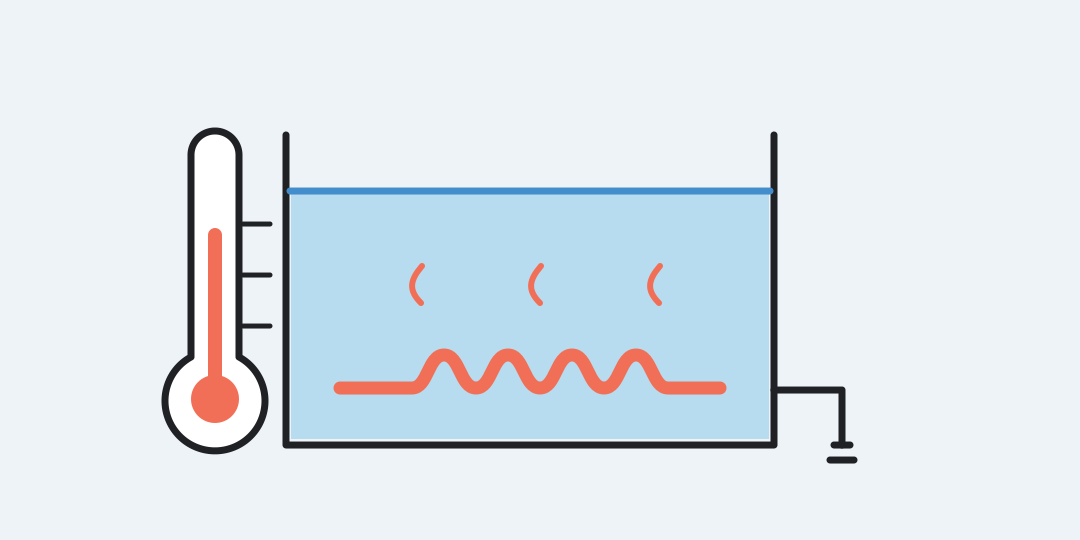
Enter the amount of water, its starting and target temperatures, heater power, and heating efficiency. The calculator estimates how long the temperature rise takes and how much energy the source must supply.
What changes the waiting time?
An 80 L storage heater. Heating water from 15 to 60 °C with a 2 kW heater at 90% efficiency needs 4.186 kWh in the water and about 4.651 kWh from the source. The idealized time is 2 h 19 min 32 s. A thermostat or a cold layer in the tank may change when a particular sensor reaches 60 °C.
One litre in a small heater. From 20 to 100 °C, 1 kW and 100% efficiency give about 0.093 kWh and 5 min 35 s. That is only the time to reach the target; keeping the water boiling or making steam requires another calculation.
A larger, less efficient tank. For 100 L from 10 to 60 °C, 2 kW and 80% efficiency, the estimate is about 3 h 38 min. The water needs 5.814 kWh, while the source supplies about 7.267 kWh. The difference is the loss implied by the efficiency you entered.
Energy first, then time
Heating time is energy demand divided by useful power. The calculator treats 1 L of water as about 1 kg and uses a specific heat capacity of 4.186 kJ/(kg·°C), a representative value tabulated by OpenStax University Physics.
Here m is water mass, c is specific heat capacity, ΔT is the temperature rise, η is efficiency as a fraction, and P is heater power. Convert Q from kilojoules to kilowatt-hours before dividing by P in kilowatts. Choose litres or US gallons and Celsius or Fahrenheit; the entered quantities convert when you change units. A Fahrenheit temperature difference is converted to Celsius degrees before the heat calculation, following the NIST temperature conversion.
Where the estimate ends
The model assumes one temperature for the whole water volume and constant heater power. It does not model tank walls, stratification, changing heat loss, thermostat cycling, or evaporation separately. Efficiency is your single combined allowance for those losses; without a measured value, compare several settings rather than treating one time as a promise.
Inputs are limited to the liquid-water range of 0–100 °C, or 32–212 °F. These bounds are a practical simplification, not a claim that water always boils at 100 °C. Ice melting and water turning into steam need phase-change energy that the formula does not include. Check actual water temperature with a thermometer before use.
Questions before heating water
The estimate is most useful for comparing volumes, heater powers and efficiency assumptions under the same conditions.
Does doubling heater power halve the time?
In this constant-efficiency model, yes. In a real heater, thermostat behavior and heat loss can change the proportion.
Why is the energy from the source greater than the heat in water?
The selected efficiency says only a fraction of supplied energy reaches the water. The difference appears as estimated losses.
Can I enter US gallons and Fahrenheit?
Yes. The calculator converts US gallons to litres and Fahrenheit readings to Celsius internally before using the heat formula.
Does this calculate time spent boiling?
No. It estimates reaching a target temperature. Continued boiling and evaporation require additional energy.
Which efficiency should I use?
Use a measured or documented value if available. Otherwise try several plausible values and read the results as scenarios, not a guaranteed completion time.
Similar calculators
You may find the following calculators on the same topic useful:
- Electric Power Calculator. Calculate the electric current power in watts (W) based on current strength, voltage, and resistance online.
- Average Speed Calculator. Calculate the online average speed of a car or runner based on time and distance.
- Friction Coefficient Calculator. Calculate the coefficient of friction based on the angle of inclination or using mass and friction force.
- Ohm's Law Calculator. Calculate resistance, current, and voltage according to Ohm's Law using the known parameters.
- Km/h to m/s Speed Conversion Calculator. Easily convert speeds from kilometers per hour to meters per second for academic, scientific, or practical use.
- m/s to Km/h Speed Conversion Calculator. Quickly convert speeds from meters per second to kilometers per hour for scientific, educational, or practical uses.
- Celsius to Fahrenheit Converter. Convert negative, whole, or decimal temperatures in either direction, with results rounded to at most two decimal places.
- Fahrenheit to Celsius Converter. Convert negative, whole, or decimal temperatures in either direction with results rounded to at most two decimal places.
- Celsius to Kelvin Converter. Convert negative, whole, or decimal Celsius values to kelvins and reverse the calculation from either field.
- Kelvin to Celsius Converter. Convert whole or decimal kelvin values to Celsius and reverse the calculation from either field.
Share on social media
If you liked it, please share the calculator on your social media platforms. It`s easy for you and beneficial for the project`s promotion. Thank you!