Contents
How the converter works
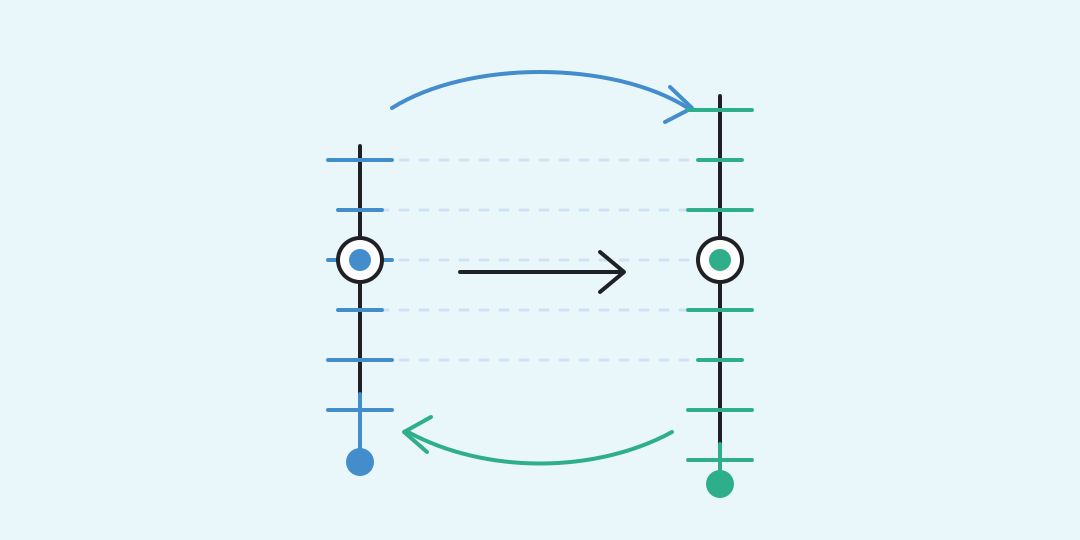
Convert Celsius to kelvin by adding 273.15. The calculator starts with 20 °C = 293.15 K, accepts negative and decimal values, and can also work backwards from the kelvin field.
Celsius and kelvin use the same size interval
Only the zero points differ. A change of 1 °C is therefore exactly the same temperature change as 1 K. To return to Celsius, use .
The kelvin is the SI base unit of thermodynamic temperature. Its symbol is K, without a degree sign. The US National Institute of Standards and Technology gives the same conversion and notation guidance.
Useful checkpoints
20 °C equals 293.15 K. This room-temperature example is a quick check that the 273.15 offset was added once.
0 °C equals 273.15 K. Water's familiar freezing reference becomes a positive absolute temperature.
-273.15 °C equals 0 K. This is absolute zero, the lower boundary of thermodynamic temperature.
Enter the value you know
Type Celsius on the left and read kelvin on the right. Editing the result performs the reverse conversion. The middle button swaps the scales, and the selectors also offer Fahrenheit and Réaumur.
Both comma and point decimal separators are accepted. Results are shown with at most two decimal places, but that display rounding does not make the original measurement more precise.
Readings need the offset; differences do not
Add 273.15 to an actual Celsius reading. Do not add it to a temperature difference: an increase from 20 °C to 25 °C is an increase of 5 K, not 278.15 K.
The conversion itself is exact. Physical reference points can still depend on conditions: for example, water's boiling temperature changes with pressure.
The fields allow arithmetic values below 0 K, but a negative kelvin result is outside the physical thermodynamic scale.
Celsius to kelvin questions
These answers address the notation and offset that most often cause mistakes.
What is the exact Celsius-to-kelvin formula?
Add 273.15: K = °C + 273.15.
What is 25 °C in kelvin?
25 °C equals 298.15 K.
Should kelvin have a degree symbol?
No. Write 293.15 K, not 293.15 °K.
Is a change of 1 °C equal to a change of 1 K?
Yes. Celsius and kelvin intervals are the same size; only their zero points differ.
Can a kelvin temperature be negative?
Not on the ordinary thermodynamic temperature scale. A calculator may return a negative arithmetic result for Celsius values below -273.15 °C, but it is not a physical temperature.
Similar calculators
You may find the following calculators on the same topic useful:
- Kelvin to Celsius Converter. Convert whole or decimal kelvin values to Celsius and reverse the calculation from either field.
- Réaumur to Celsius Converter. Convert whole, negative, or decimal Réaumur values to Celsius and reverse the calculation from either field.
- Réaumur to Fahrenheit Converter. Convert whole, negative, or decimal Réaumur values to Fahrenheit and reverse the calculation from either field.
- Pounds to Kilograms Converter. Enter a mass in pounds or kilograms and get the matching value immediately.
- Ounces to grams converter. Enter a mass in ounces or grams and the matching value appears immediately.
- Knots to km/h converter. Enter a speed in knots or km/h and see the equivalent value immediately.
- PSI to bar converter. Enter pressure in psi or bar and see the equivalent value immediately in the other field.
- RPM to hertz converter. Enter a rotational speed in rpm or hertz and get the matching number of full revolutions per second or minute.
- Bar to pascal converter. Enter pressure in bar or pascals and see the exact equivalent in the other field.
- Atmospheres to kilopascals converter. Enter pressure in standard atmospheres or kilopascals and get the exact equivalent immediately.
Share on social media
If you liked it, please share the calculator on your social media platforms. It`s easy for you and beneficial for the project`s promotion. Thank you!