Contents
How the RPM to hertz converter works
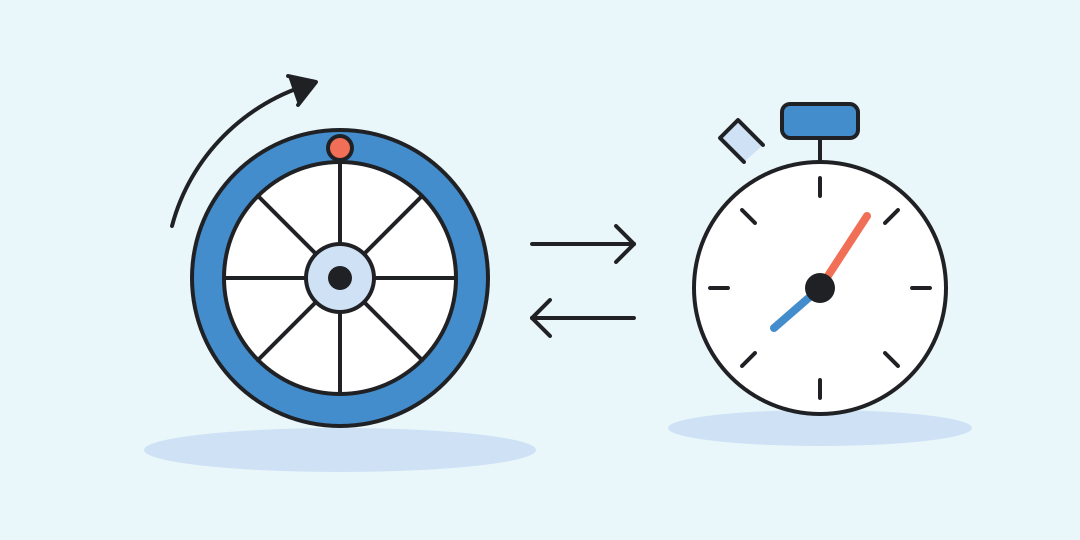
Enter a mechanical speed in either field. The converter divides revolutions per minute by 60 to show complete revolutions per second in hertz, or multiplies hertz by 60 for the reverse conversion.
One minute is the whole conversion factor
RPM counts complete turns during 60 seconds. Hertz counts cycles during one second. When one cycle means one complete turn, the relationship is:
Here n is rotational speed in rpm and f is mechanical rotational frequency in hertz. Wheel diameter, motor power and shaft material do not change this unit conversion.
Useful speeds to recognise
A spindle at 3000 rpm turns at 50 Hz. It completes fifty full revolutions every second. This is a mechanical frequency, even if the number happens to match a 50 Hz mains supply.
A fan at 1200 rpm turns at 20 Hz. The blades pass a fixed point more often than twenty times per second when the fan has several blades, so blade-pass frequency is a separate calculation.
A record at 33⅓ rpm turns at about 0.555556 Hz. One revolution takes about 1.8 seconds. The fractional answer is expected because the record does not complete a full turn each second.
A cycle is not always a revolution
The conversion is exact only after the cycle has been defined as one mechanical revolution. An encoder can emit hundreds of pulses per turn, a multi-blade fan produces several blade passages per turn, and an electric motor can rotate at a speed different from its supply frequency.
- Use pulses per revolution to obtain an encoder signal rate.
- Use blade count to estimate a blade-pass frequency.
- Use motor poles and machine data to relate supply frequency to shaft speed.
Use the calculator for a known shaft, wheel, disc or rotor speed. To find sensor pulse frequency, multiply the rotational frequency by pulses per revolution. To derive motor speed from electrical frequency, the motor type, pole count and sometimes slip are also required.
Decimals, zero and direction
Values that are not multiples of 60 naturally produce decimal hertz. Keep only as many digits as the original measurement supports: a tachometer reading rounded to whole rpm does not justify twelve meaningful decimal places.
Zero rpm equals zero hertz because nothing completes a revolution. The form uses non-negative speed; clockwise or counter-clockwise direction must be recorded separately when it matters.
Questions about RPM and hertz
These answers separate a direct unit conversion from related electrical and sensor frequencies.
How many rpm equal 1 Hz?
One mechanical revolution per second equals 60 revolutions per minute, so 1 Hz equals 60 rpm.
What is 1500 rpm in hertz?
It is 25 Hz when one cycle represents one complete revolution.
Does 50 Hz always mean 3000 rpm for a motor?
No. That equality is only the unit conversion for mechanical rotation. Motor speed also depends on pole count, machine type, load and possible slip.
Why can the result be below 1 Hz?
A slow object may need more than one second for a full turn. For example, 30 rpm equals 0.5 Hz.
Can I convert hertz back to rpm?
Yes. Enter hertz in the second field or swap the direction; the converter multiplies the value by 60.
Similar calculators
You may find the following calculators on the same topic useful:
- Bar to pascal converter. Enter pressure in bar or pascals and see the exact equivalent in the other field.
- Atmospheres to kilopascals converter. Enter pressure in standard atmospheres or kilopascals and get the exact equivalent immediately.
- Metric horsepower to kilowatts converter. Enter power in metric horsepower or kilowatts and get the equivalent value immediately.
- Liters to milliliters converter. Enter a volume in liters or milliliters and see the equivalent value immediately.
- Capacitor energy calculator. Enter capacitance and voltage to calculate ideal stored energy, charge, millijoules and watt-hours.
- Voltage divider calculator. Enter the source voltage and two resistor values to calculate the unloaded output and circuit current.
- Water mixing temperature calculator. Enter two water volumes and temperatures to estimate the ideal mixture temperature and proportions.
- Density calculator. Choose the unknown quantity, enter two measurements, and get density, mass, or volume in the unit you need.
- Kilojoules to kilocalories converter. Enter an energy value in kJ or kcal and see the equivalent amount immediately.
- Miles per hour to kilometres per hour converter. Enter a speed in mph or km/h and see the equivalent value immediately.
Share on social media
If you liked it, please share the calculator on your social media platforms. It`s easy for you and beneficial for the project`s promotion. Thank you!