Contents
How the battery runtime calculator works
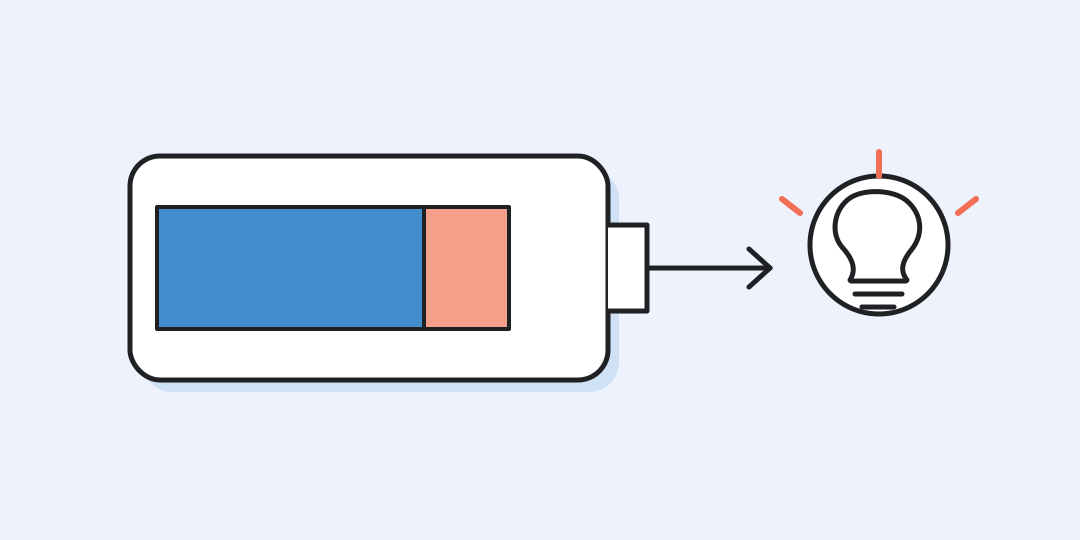
Enter battery capacity, voltage and average load to estimate operating time, or enter a target time to find the capacity it calls for.
Energy available to the load
Ampere-hours alone do not describe the energy in a battery. Multiply capacity by voltage to obtain nominal watt-hours, then allow for the discharge limit and conversion losses. The load consumes the remaining energy at the entered average rate.
Here, is usable discharge and is system efficiency, both entered as percentages and used as fractions. The result is an estimate, not a promise of uninterrupted operation.
Three ways to use the result
- Backup battery: 100 Ah at 12 V, a 120 W average load, 80% usable discharge and 90% efficiency yield 864 Wh for the equipment and 7 h 12 min of estimated runtime. Plan a margin if seven hours is a strict requirement.
- Choose capacity: For the same 120 W load and 12 V system, enter a six-hour target with 80% discharge and 90% efficiency. The calculator returns 83.33 Ah. A real battery must be selected from available rated sizes and its specifications checked.
- Small device: A 7 Ah, 12 V battery feeding a 12 W average load at 80% discharge and 90% efficiency produces 5 h 2 min 24 s. This is longer than simply dividing 7 by 12 because Ah and W are not compatible units until voltage is included.
Inputs, rounding and limits
Capacity is in Ah, voltage in V, power in W and desired time in hours. Use the average power actually drawn while the devices run together, not a brief startup peak. Percentages must lie from 1 to 100. Displayed time is rounded to the nearest second and capacity to two decimals.
Battery voltage can change during discharge; usable capacity also depends on current, temperature, age and the battery’s discharge limit. An inverter or converter may have a different efficiency at different loads. For critical backup power, measure consumption and follow equipment specifications rather than treating this simple constant-average model as a safety assessment.
Battery runtime questions
Why does the calculator ask for voltage?
Ah measures charge, while the load is entered in watts. Voltage converts the battery rating to watt-hours so the units can be compared.
What is usable discharge?
It is the fraction of nominal battery capacity you intend to use before stopping. Enter the limit relevant to your battery and equipment.
Should I enter peak or average power?
Use average power over the planned operating period. A startup peak matters for hardware selection but does not represent continuous energy use.
Does the capacity result include system losses?
Yes. The reverse calculation divides the load's required energy by usable discharge and efficiency.
Can I use this result to choose an inverter?
No. Runtime does not establish safe voltage, current, surge handling or equipment compatibility. Check manufacturer specifications.
Similar calculators
You may find the following calculators on the same topic useful:
- Absolute humidity calculator. Enter air temperature and relative humidity to find the water vapor in one cubic meter of air.
- Hydrostatic pressure calculator. Enter depth and fluid properties to find the pressure at a point below the surface.
- Water heating time calculator. Enter the amount of water and your heater's power to estimate the wait and energy use.
- Electric Power Calculator. Calculate the electric current power in watts (W) based on current strength, voltage, and resistance online.
- Average Speed Calculator. Calculate the online average speed of a car or runner based on time and distance.
- Friction Coefficient Calculator. Calculate the coefficient of friction based on the angle of inclination or using mass and friction force.
- Ohm's Law Calculator. Calculate resistance, current, and voltage according to Ohm's Law using the known parameters.
- Km/h to m/s Speed Conversion Calculator. Easily convert speeds from kilometers per hour to meters per second for academic, scientific, or practical use.
- m/s to Km/h Speed Conversion Calculator. Quickly convert speeds from meters per second to kilometers per hour for scientific, educational, or practical uses.
- Celsius to Fahrenheit Converter. Convert negative, whole, or decimal temperatures in either direction, with results rounded to at most two decimal places.
Share on social media
If you liked it, please share the calculator on your social media platforms. It`s easy for you and beneficial for the project`s promotion. Thank you!