Contents
How this pressure calculator works
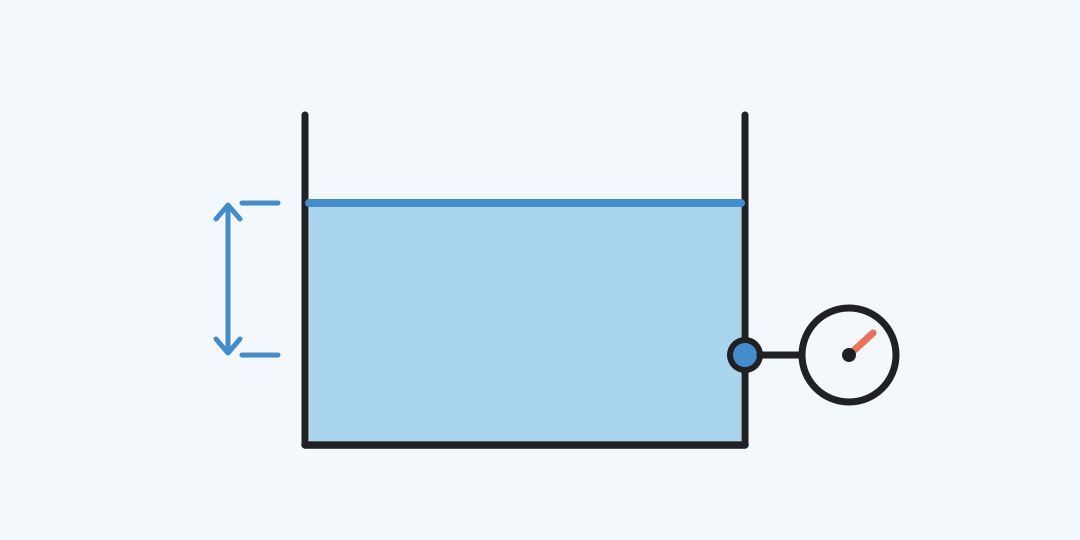
A motionless liquid adds pressure as depth increases. Enter the vertical distance below its surface, its density, gravity and the pressure acting on the surface. The main answer is the extra, or gauge, pressure at that point; the card also shows absolute pressure.
Which pressure does the formula return?
The liquid's contribution depends on the weight of the column above the point, not the width of the tank. For a liquid of nearly constant density in a uniform gravitational field, the relation is:
Here h is vertical depth, ρ is density, g is gravitational acceleration and p0 is absolute pressure at the surface. OpenStax derives the same relation for a static fluid of constant density. [OpenStax, University Physics]
Choose metric for metres, kg/m³, m/s² and kPa, or imperial for feet, lb/ft³, ft/s² and psi. Switching systems converts the entered scenario instead of treating the same number as a different measurement. The result is rounded for display only.
Compare a deep point with a shallow one
Ten metres of water. With density 1000 kg/m³ and g = 9.81 m/s², the liquid adds 98.1 kPa. If surface pressure is 101.325 kPa, absolute pressure is 199.425 kPa. The surface figure is a standard-atmosphere example, not today's local barometer reading.
Half a metre below the surface. At the same density and gravity, the increase is only 4.905 kPa. Absolute pressure is 106.23 kPa with the same 101.325 kPa at the top. Measure the depth to the actual sensor, not to the bottom of the tank.
A less dense liquid. At 3 m with density 800 kg/m³, the increase is 23.544 kPa and absolute pressure is 124.869 kPa when the surface remains at 101.325 kPa. Substituting water's 1000 kg/m³ would overstate this example.
Where the simple model stops
At zero depth the added pressure is zero and absolute pressure equals the entered surface pressure. The default 101.325 kPa is exactly one standard atmosphere, according to NIST's SI guide; it is not a live weather measurement.
The model assumes a still, uniform liquid. Flow, layers with different densities, large density changes and pump pressure require more information. The answer is pressure at one point, not the total force on a wall or an equipment pressure rating. For a layered tank, calculate ρgh separately for each layer and add the contributions.
Questions about pressure at depth
Before comparing a gauge reading, establish whether the instrument reports pressure relative to the surroundings or relative to a vacuum.
Why are there gauge and absolute results?
Gauge pressure is the increase from the liquid column. Absolute pressure also includes the absolute pressure already acting on the surface.
Do I enter the tank height or sensor depth?
Enter the vertical depth from the liquid surface to the point whose pressure you need. Tank height matters only if the point is at its bottom.
Can surface pressure be zero?
Yes, for a theoretical surface in a vacuum. At depth zero the absolute result then also equals zero.
What if the liquid has two layers?
This single-density form cannot model both at once. Calculate density times gravity times thickness for each layer and add those pressure increases.
Does tank width change pressure at a point?
No. For the same liquid, surface pressure, gravity and vertical depth, the pressure at the point is the same. Width changes volume and possibly total force, not this local pressure.
Similar calculators
You may find the following calculators on the same topic useful:
- Water heating time calculator. Enter the amount of water and your heater's power to estimate the wait and energy use.
- Electric Power Calculator. Calculate the electric current power in watts (W) based on current strength, voltage, and resistance online.
- Average Speed Calculator. Calculate the online average speed of a car or runner based on time and distance.
- Friction Coefficient Calculator. Calculate the coefficient of friction based on the angle of inclination or using mass and friction force.
- Ohm's Law Calculator. Calculate resistance, current, and voltage according to Ohm's Law using the known parameters.
- Km/h to m/s Speed Conversion Calculator. Easily convert speeds from kilometers per hour to meters per second for academic, scientific, or practical use.
- m/s to Km/h Speed Conversion Calculator. Quickly convert speeds from meters per second to kilometers per hour for scientific, educational, or practical uses.
- Celsius to Fahrenheit Converter. Convert negative, whole, or decimal temperatures in either direction, with results rounded to at most two decimal places.
- Fahrenheit to Celsius Converter. Convert negative, whole, or decimal temperatures in either direction with results rounded to at most two decimal places.
- Celsius to Kelvin Converter. Convert negative, whole, or decimal Celsius values to kelvins and reverse the calculation from either field.
Share on social media
If you liked it, please share the calculator on your social media platforms. It`s easy for you and beneficial for the project`s promotion. Thank you!