Contents
How the fraction becomes a decimal
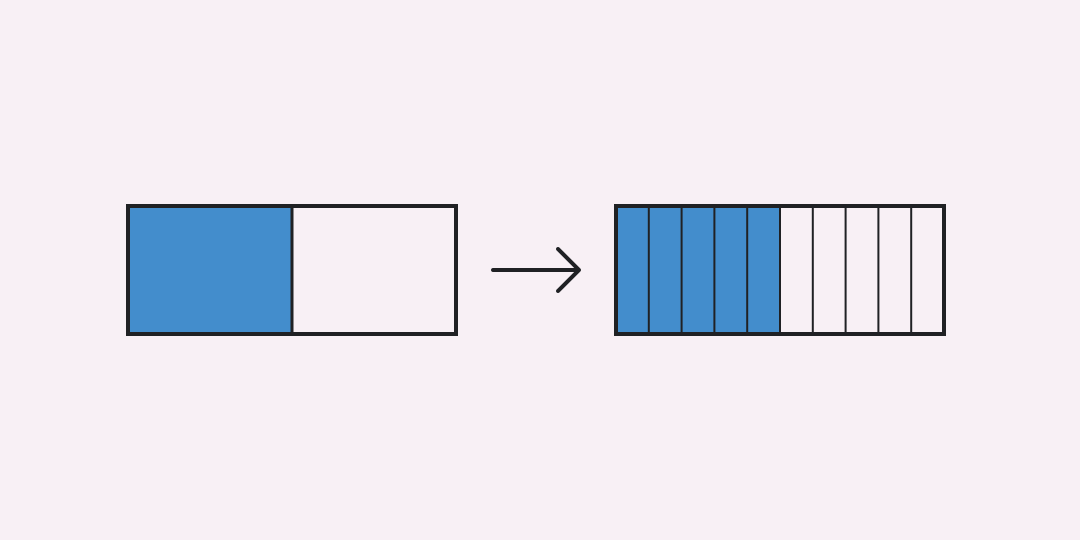
Divide the numerator by the positive denominator. The calculator also accepts a whole part for mixed numbers and shows whether the decimal fits exactly within the chosen number of places.
Enter a fraction you can recognize
Put the number above the fraction bar in Numerator and the number below it in Denominator. Leave Whole part at 0 for an ordinary fraction. A whole part of 2 with numerator 1 and denominator 4 represents 2 1/4.
For an ordinary fraction, n is the numerator and d is the denominator. The decimal comes from division. For a mixed number, add the fractional part to the whole part; if that whole part is negative, its minus sign applies to the entire mixed number.
Check the answer with small numbers
Enter whole part 0, numerator 3 and denominator 4. Three divided by four is exactly 0.75, so two decimal places are sufficient. This is the same shaded share as 75 out of 100 parts.
Enter 1, 2 and 3 with two decimal places. The value is 1.666..., so the calculator shows 1.67 and marks it as rounded. Increasing the place count gives a closer decimal approximation, not an exact finite one.
Enter −2, 1 and 4. The conventional mixed number is −(2 + 1/4), so the answer is −2.25. The minus belongs to the whole amount, not only to the 2.
Precision, signs and input limits
Choose from 0 to 10 decimal places. Results are rounded to the nearest value at that precision, with an exact halfway case rounded away from zero. Trailing zeros are hidden: 1/2 shows 0.5 rather than 0.50. Use the copy button to get the ungrouped result with a decimal point.
Each input must be an integer of at most 15 digits. The denominator must be positive. A negative numerator is allowed for an ordinary fraction when the whole part is 0; for a negative mixed number, put the minus on its whole part and keep the numerator nonnegative. A denominator of zero cannot be divided by.
An exact decimal at the selected precision means no further digits are needed. For example, 1/8 is 0.125 exactly at three places but appears as the rounded 0.13 at two. To turn an improper fraction into a mixed number without decimals, use the mixed-number converter.
Questions about decimal fractions
The distinction between a finite answer and a rounded display matters when you reuse the number.
Does every fraction have a finite decimal?
No. For example, 1/3 repeats forever. The calculator shows the requested number of decimal places and labels that display as rounded.
What happens if I select zero decimal places?
The answer is rounded to a whole number. For example, 2/3 becomes 1, while 1/3 becomes 0.
Can I enter a negative simple fraction?
Yes. Set the whole part to 0 and use a negative numerator with a positive denominator. For example, −1/2 becomes −0.5.
Why is 1/8 sometimes 0.13?
At two decimal places, the exact value 0.125 is halfway between 0.12 and 0.13. This calculator rounds that tie away from zero.
Can the denominator be negative?
No. Keep the denominator positive and place the minus on the numerator for a simple fraction, or on the whole part for a mixed number.
Similar calculators
You may find the following calculators on the same topic useful:
- Coefficient of variation calculator. Enter a list of numbers to see their relative spread as a percentage.
- Variance calculator. Paste numbers, choose a data type, and see how far the values spread around their mean.
- Percentile and percentile rank calculator. Enter numbers, then choose a percentile or compare one value with the list.
- Bayes theorem calculator. Use the event rate, signal sensitivity and false-alarm rate to update the probability after a signal.
- Sample size calculator. Choose your precision and confidence level to estimate how many usable answers to collect.
- Simple Calculator. Simply calculate whatever you need.
- Pi Calculator. Find out the value of Pi with the desired number of decimal places.
- Calculator for the Number 'e'. Calculate the desired number of decimal places in the number 'e' (Euler's number or Napier's constant) using the 'e' number calculator.
- Quadratic Equations Calculator. Apply methods to solve quadratic equations using formulas, discriminant, and Vieta's theorem.
- Percentage Less Calculator. Calculate online how much one number is less than another in percentage.
Share on social media
If you liked it, please share the calculator on your social media platforms. It`s easy for you and beneficial for the project`s promotion. Thank you!