Contents
How the dew point calculator works
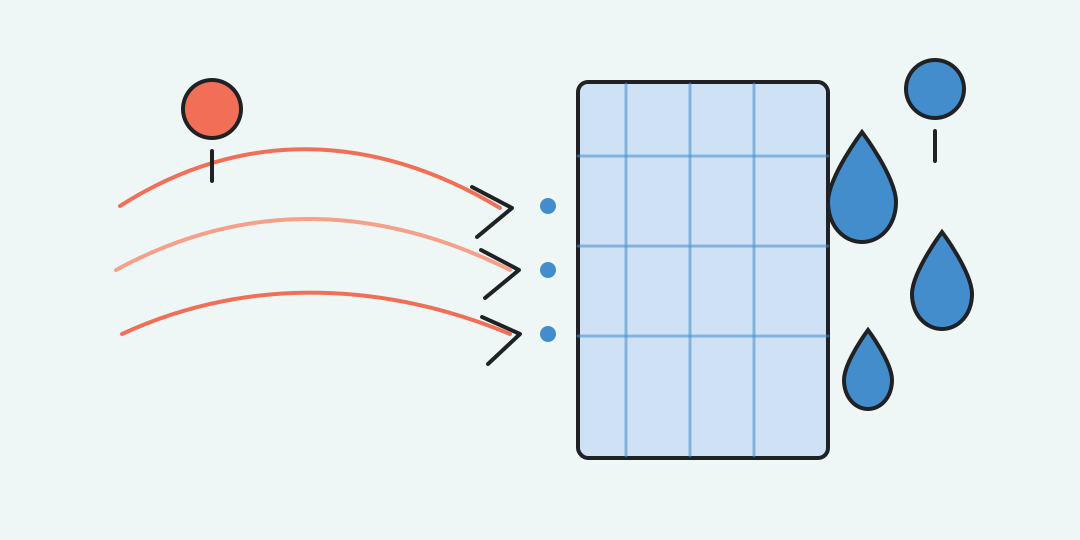
Enter the air temperature and relative humidity to find the dew point. Add a surface temperature to check whether a window, wall, mirror, or pipe is cold enough for condensation under the same conditions.
The calculation finds the saturation temperature
Dew point is the temperature to which air must cool, at the same pressure and water-vapor content, to reach 100% relative humidity. The calculator uses a Magnus-form approximation with a = 17.625 and b = 243.04 °C.
Here T is air temperature in Celsius, RH is relative humidity in percent, and Td is the dew point. Fahrenheit inputs are converted to Celsius for the formula and converted back for display. Alduchov and Eskridge compared improved Magnus equations for saturation vapor pressure in their 1996 paper. [Alduchov and Eskridge, 1996]
Three useful surface checks
Ordinary room. At 22 °C and 55% RH, the dew point is about 12.5 °C. A wall at 18 °C stays 5.5 °C above it, so this simple model does not expect condensation.
Cold window. Keep the same air but change the inner glass temperature to 10 °C. The glass is 2.5 °C below the dew point, so droplets are likely. The critical humidity for that surface is about 46.5%.
Bathroom mirror. At 25 °C and 80% RH, the dew point is about 21.3 °C. An 18 °C mirror falls 3.3 °C below that threshold and can fog quickly.
A small positive margin still deserves a second measurement
The surface margin is surface temperature minus dew point. Positive means the entered spot is warmer than the dew point; zero or negative means saturation is possible at that spot. A window edge, wall corner, area behind furniture, or metal fitting may be colder than the place you measured.
The National Weather Service describes dew point as the temperature at which air becomes saturated and water vapor begins to condense. It also notes that relative humidity changes with air temperature, while dew point follows the actual moisture content more directly. [National Weather Service]
This calculator assumes uniform, steady air and saturation over liquid water. It does not diagnose leaks, ventilation, moisture inside a wall, thermal bridges, airflow, or frost formation. Below freezing, a frost-point calculation may be more appropriate.
Questions about dew point and condensation
These answers separate the calculated threshold from a full inspection of a room or building.
Can dew point be higher than the air temperature?
Not when relative humidity is at or below 100% in this equilibrium model. At 100% it equals the air temperature; at lower humidity it is below it.
What does critical humidity mean?
It is the relative humidity at which the entered surface temperature becomes the dew point. Above that value, condensation on that surface is likely in the model.
Which temperature should I measure on a window?
Check the center, the lower edge, and a corner. The coldest point matters most, and it is often not the center of the glass.
Does a positive margin prove that the room is safe from damp?
No. It describes only the entered air and surface temperatures. Hidden moisture, colder spots, changing weather, and measurement error can still matter.
Can I use Fahrenheit?
Yes. Select Fahrenheit and enter both temperatures in °F. The calculator converts the physical scenario internally and returns the dew point and temperature gaps in °F.
Is this a mold-risk calculator?
No. Mold growth depends on surface humidity over time, material, temperature, nutrients, and other conditions. Dew point is one useful threshold, not a diagnosis.
Similar calculators
You may find the following calculators on the same topic useful:
- Battery runtime calculator. Enter battery details and average load to estimate operating time or the capacity needed for a target duration.
- Absolute humidity calculator. Enter air temperature and relative humidity to find the water vapor in one cubic meter of air.
- Hydrostatic pressure calculator. Enter depth and fluid properties to find the pressure at a point below the surface.
- Water heating time calculator. Enter the amount of water and your heater's power to estimate the wait and energy use.
- Electric Power Calculator. Calculate the electric current power in watts (W) based on current strength, voltage, and resistance online.
- Average Speed Calculator. Calculate the online average speed of a car or runner based on time and distance.
- Friction Coefficient Calculator. Calculate the coefficient of friction based on the angle of inclination or using mass and friction force.
- Ohm's Law Calculator. Calculate resistance, current, and voltage according to Ohm's Law using the known parameters.
- Km/h to m/s Speed Conversion Calculator. Easily convert speeds from kilometers per hour to meters per second for academic, scientific, or practical use.
- m/s to Km/h Speed Conversion Calculator. Quickly convert speeds from meters per second to kilometers per hour for scientific, educational, or practical uses.
Share on social media
If you liked it, please share the calculator on your social media platforms. It`s easy for you and beneficial for the project`s promotion. Thank you!