Contents
How the LCM calculator works
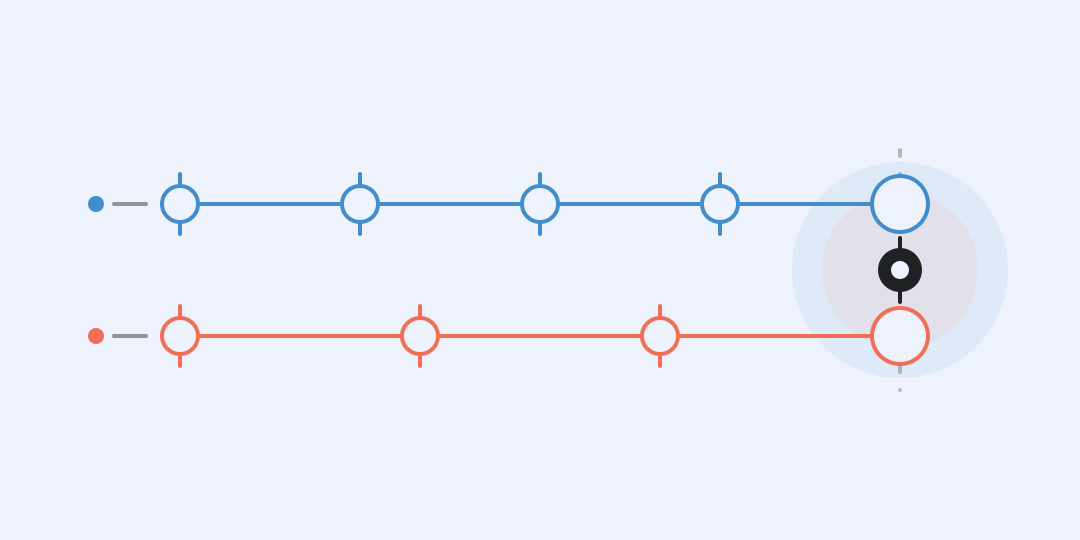
Enter two integers. The calculator returns their least common multiple and can reveal the GCD, Euclidean divisions and the exact substitution used to obtain it.
The first positive multiple shared by both numbers
For two nonzero integers, the LCM is the smallest positive integer divisible by each input without a remainder. Signs are ignored, so 21 and 6 have the same LCM as -21 and 6.
Dividing by the GCD before multiplying keeps the intermediate value smaller and exact. For 48 and 18, the GCD is 6, so |48 ÷ 6 × 18| = 144.
Three ways to use the answer
- Synchronise cycles: events repeating every 6 and 8 minutes meet again after 24 minutes.
- Find a common denominator: denominators 12 and 18 have LCM 36, so the fractions can be converted to thirty-sixths.
- Plan equal batches: pack sizes of 15 and 20 both fit exactly into a total of 60 items.
Two coprime inputs have an LCM equal to their product. That is why LCM(13, 17) = 221.
Zero, signs and exact limits
If either input is zero, the calculator returns 0 by the standard computational convention and skips the division formula. This also makes LCM(0, 0) unambiguous inside the tool.
The LCM is never negative, even when one or both inputs are negative.
Each input may contain up to 100 digits. The result can be longer than either input and is calculated without rounding. Decimal fractions, exponent notation and letters are rejected.
Questions about least common multiples
The short answers below cover common denominators, zero and the relation between GCD and LCM.
What does LCM mean?
It is the least common multiple: the smallest positive number divisible by both nonzero inputs.
How is an LCM different from a GCD?
The LCM is a shared multiple above the inputs, while the GCD is the largest shared divisor. Their product equals the absolute product of the two inputs.
Why is LCM(0, 25) equal to 0?
Integer arithmetic convention defines the LCM of any pair containing zero as zero. The calculator handles it without division.
Can the LCM be smaller than both inputs?
For nonzero integers it is at least as large as the greater absolute value. Equal inputs have an LCM equal to that value.
How does the LCM help add fractions?
The LCM of the denominators gives the least common denominator, reducing the amount by which each fraction must be expanded.
Are long results rounded?
No. Inputs up to 100 digits are processed with exact integer arithmetic.
Similar calculators
You may find the following calculators on the same topic useful:
- Z-score calculator. Compare a value with its group mean or recover the original value from a known Z-score.
- Megabits to megabytes converter. Enter a value in Mb or MB and see the equivalent data quantity immediately.
- Standard deviation calculator. Paste a numerical list, choose population or sample, and control the displayed precision without rounding the internal result.
- Mean, median and mode calculator. Paste a list of numbers to compare its mean, median, mode, range and endpoints.
- Quartile and interquartile range calculator. Paste a number list to measure its central half and identify observations beyond the inner fences.
- Time converter. Enter a duration and convert it instantly between common short, everyday, and average calendar units.
- Geometric mean calculator. Enter positive values to find their representative multiplicative factor.
- Harmonic mean calculator. Enter positive rates or ratios to see their harmonic mean.
- Arrangements and permutations calculator. Choose how many distinct elements to arrange and get every digit of the answer.
- Improper fraction to mixed number calculator. Enter an integer numerator and positive denominator to see the whole units and simplified remainder.
Share on social media
If you liked it, please share the calculator on your social media platforms. It`s easy for you and beneficial for the project`s promotion. Thank you!