Contents
How the Z-score calculator works
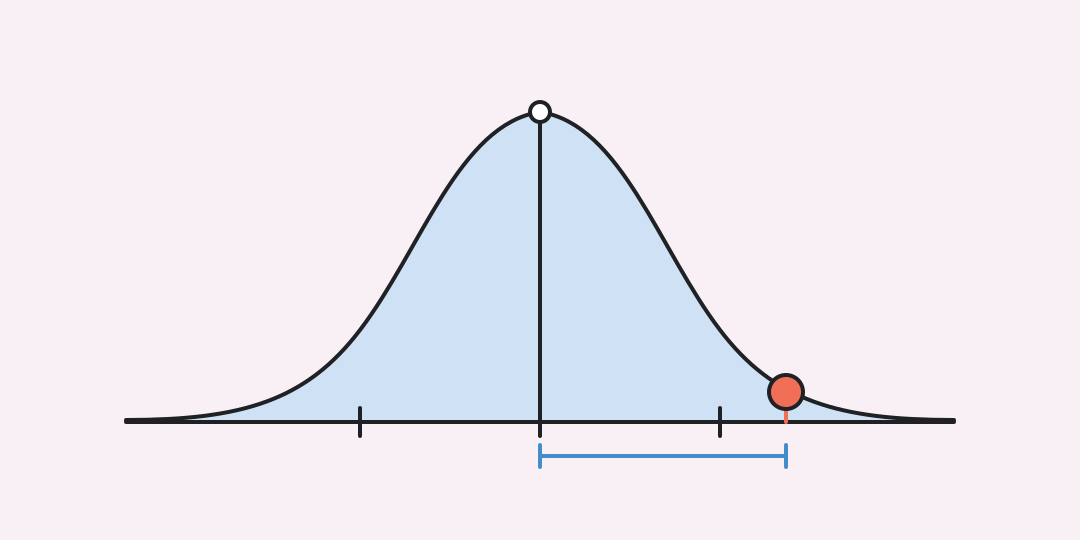
Enter a raw value, its group mean and the standard deviation. The calculator reports how many standard deviations separate the value from the mean, or reverses the calculation when a Z-score is already known.
One number makes different scales comparable
A Z-score replaces the original unit with distance from the mean. Subtract the mean from the observed value and divide by the standard deviation.
Read the sign first, then the distance: direction and size answer different questions.
A positive result sits above the mean, a negative result below it, and zero exactly at it. For example, a score of 85 in a group with mean 70 and standard deviation 10 has z = 1.5. A result from another test can be compared by its relative position even when that test uses a different point scale.
The score has no unit. The units carried by x, μ and σ cancel during division.
Recovering the raw value
Choose “Raw value” when the mean, standard deviation and Z-score are known. The inverse formula restores the value in the original unit.
With a mean of 50, a standard deviation of 10 and z = 1.2, the raw value is 62. A negative Z-score moves the answer below the mean automatically.
What the result does not say
A Z-score is not a percentile or a probability. Turning it into either one requires a distribution model, commonly a normal distribution. The calculation itself only needs a valid mean and a positive standard deviation.
Use the mean and deviation from the same population or sample. A large absolute score marks a distant observation, but deciding whether it is an error or an outlier still depends on the data and the subject.
Questions about Z-scores
These answers cover the sign, units and the assumptions that are easy to mix up.
What does a Z-score of zero mean?
The raw value equals the mean. The numerator x minus μ is zero, so the result remains zero for every positive standard deviation.
Can a Z-score be negative?
Yes. A negative score means that the value lies below the mean. Its absolute value gives the distance in standard deviations.
Does Z = 2 mean 2 percent?
No. It means two standard deviations above the mean. A percentage or percentile requires additional information about the distribution.
Why must the standard deviation be positive?
It is the divisor in the formula. Zero would make division undefined, and a standard deviation cannot be negative by definition.
Do I need normally distributed data?
Not to calculate a Z-score. Normality becomes relevant only when the score is used to estimate areas, probabilities or percentiles from a normal model.
Can I compare Z-scores from different tests?
Yes, when each score uses the correct mean and standard deviation for its own reference group. Equal Z-scores describe equal relative positions, not equal raw measurements.
Similar calculators
You may find the following calculators on the same topic useful:
- Megabits to megabytes converter. Enter a value in Mb or MB and see the equivalent data quantity immediately.
- Standard deviation calculator. Paste a numerical list, choose population or sample, and control the displayed precision without rounding the internal result.
- Mean, median and mode calculator. Paste a list of numbers to compare its mean, median, mode, range and endpoints.
- Quartile and interquartile range calculator. Paste a number list to measure its central half and identify observations beyond the inner fences.
- Time converter. Enter a duration and convert it instantly between common short, everyday, and average calendar units.
- Geometric mean calculator. Enter positive values to find their representative multiplicative factor.
- Harmonic mean calculator. Enter positive rates or ratios to see their harmonic mean.
- Arrangements and permutations calculator. Choose how many distinct elements to arrange and get every digit of the answer.
- Improper fraction to mixed number calculator. Enter an integer numerator and positive denominator to see the whole units and simplified remainder.
- Fraction comparison calculator. Enter two integer numerators and positive denominators to compare their values.
Share on social media
If you liked it, please share the calculator on your social media platforms. It`s easy for you and beneficial for the project`s promotion. Thank you!