Contents
How the fraction comparison works
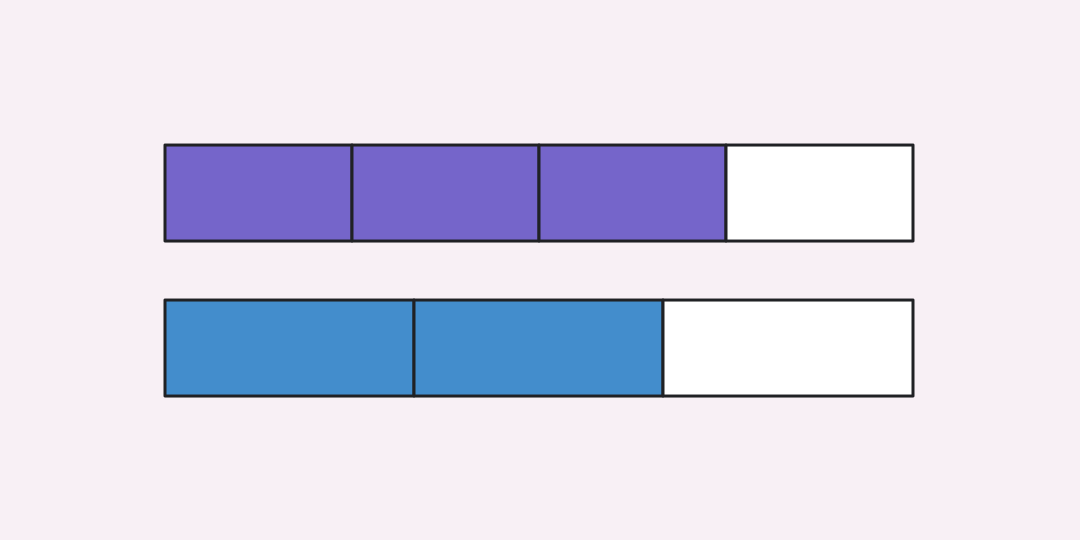
Enter two fractions with positive denominators. The calculator multiplies across them and compares the exact integer products, so it can tell which fraction is greater without converting either one to a rounded decimal.
Compare across a common denominator
For a/b and c/d, the first cross-product is a × d and the second is c × b. Because b and d are positive, whichever product is larger belongs to the larger fraction.
The sign can be greater than, less than, or equal to. Equal products mean equivalent fractions, even when their numerators and denominators look different.
Compare close, equal and negative values
For 3/4 and 2/3, the products are 3 × 3 = 9 and 2 × 4 = 8. Since 9 is larger, 3/4 > 2/3. The first bar in the illustration therefore covers more of a whole.
For 1/2 and 2/4, both products are 4. The calculator returns 1/2 = 2/4: dividing a whole into more pieces does not change the amount when twice as many pieces are taken.
For −2/3 and −3/4, the products are −8 and −9. Since −8 is greater, −2/3 > −3/4. Among negative values, the one closer to zero is greater.
Input rules and exactness
Each field accepts an integer of up to 60 digits. Numerators can be negative or zero; denominators must be positive. A zero denominator does not define a fraction. The tool uses exact integer arithmetic, so a large cross-product is not rounded.
If both denominators are the same, comparing the numerators is quicker. For general fractions, cross-multiplication gives the same answer without first reducing them. For addition or subtraction, use the fraction calculator.
Questions about comparing fractions
These cases clarify what the comparison sign means and which inputs the calculator accepts.
Do I have to simplify first?
No. Equivalent fractions have equal cross-products even before simplification. For 1/2 and 2/4, both products are 4.
Can a numerator be zero?
Yes. Zero divided by any positive denominator is zero; 0/7 and 0/3 compare as equal.
Why must denominators be positive?
A positive product of the denominators preserves the comparison direction when both fractions are put over one common denominator.
Does the calculator round recurring decimals?
No. It compares integer products directly, so a recurring decimal never needs to be written or rounded.
Can I enter a mixed number?
Enter it as an improper fraction first. For example, 2 1/3 becomes 7/3, which can then be compared exactly.
Similar calculators
You may find the following calculators on the same topic useful:
- Prime factorization calculator. Enter a nonzero whole number to see its prime factors and their exponents.
- Expected value calculator. Enter each possible outcome and its percentage probability to find the long-run average and spread.
- Time duration calculator. Enter a start and end time to find the net duration, then add more intervals when the time is split.
- Fraction addition calculator. Enter two fractions, choose an operation and get an exact reduced answer.
- Divisors of a number calculator. Enter a positive whole number to see how many divisors it has, then open the complete list.
- Mean absolute deviation calculator. Enter numbers to see how far they lie from their arithmetic mean on average.
- Median absolute deviation calculator. Enter numbers to find the typical distance from their median.
- Fraction to decimal calculator. Enter a numerator and denominator to see the decimal value; add a whole part if needed.
- Coefficient of variation calculator. Enter a list of numbers to see their relative spread as a percentage.
- Variance calculator. Paste numbers, choose a data type, and see how far the values spread around their mean.
Share on social media
If you liked it, please share the calculator on your social media platforms. It`s easy for you and beneficial for the project`s promotion. Thank you!