Contents
How the calculator measures spread
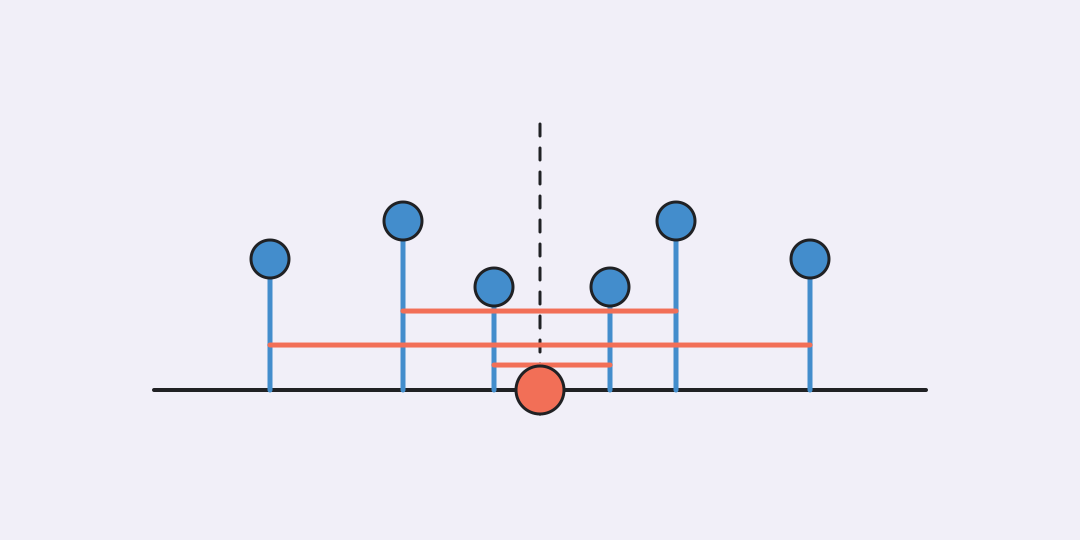
The calculator finds the arithmetic mean of your numbers, measures each number’s absolute distance from it, then averages those distances.
From a list to one distance
Enter at least one number. Separate entries with spaces, line breaks or semicolons. The main answer is in the same unit as your data: a result of 2 for lengths measured in metres means an average distance of 2 metres from the mean.
The vertical bars discard the sign of each difference. This is not the median absolute deviation, which uses a median as its centre, nor standard deviation, which squares the distances before averaging.
Three checks you can reproduce
Eight observations: enter 2, 4, 4, 4, 5, 5, 7, 9. The mean is 5; absolute distances total 12. Dividing by eight gives 1.5, so a typical observation lies 1.5 units from 5.
Three consecutive values: enter 1, 2, 3. Their mean is 2 and distances are 1, 0, 1. The answer is 2/3, about 0.667: the set is tightly clustered around 2.
Repeated measurement: enter 7, 7, 7. Every distance from the mean 7 is zero, so the answer is 0. There is no spread within this list.
Reading and entering the result
Use either a dot or comma for decimals; write 1,5 as one value and 1, 5 as two. Scientific notation works too. Do not add thousands separators: 1 000 becomes two observations.
Changing decimal places affects display only. The calculator accepts up to 10,000 values and 200,000 characters. Very large numbers and differences below floating-point resolution may be rejected instead of shown as a misleading answer.
Common questions
Can the mean absolute deviation be negative?
No. Absolute distances are nonnegative, so their average cannot be negative.
What happens with one number?
Its mean equals that number, making the distance and result zero.
Does the order of numbers matter?
No. Reordering the same observations leaves both the mean and the average absolute distance unchanged.
Is this the same as standard deviation?
No. Standard deviation squares deviations before averaging and takes a square root; the two measures can differ substantially.
Can I use decimal commas?
Yes. A comma without a following space is read as a decimal mark; use a semicolon or line break if you want an unambiguous separator.
Similar calculators
You may find the following calculators on the same topic useful:
- Median absolute deviation calculator. Enter numbers to find the typical distance from their median.
- Fraction to decimal calculator. Enter a numerator and denominator to see the decimal value; add a whole part if needed.
- Coefficient of variation calculator. Enter a list of numbers to see their relative spread as a percentage.
- Variance calculator. Paste numbers, choose a data type, and see how far the values spread around their mean.
- Percentile and percentile rank calculator. Enter numbers, then choose a percentile or compare one value with the list.
- Bayes theorem calculator. Use the event rate, signal sensitivity and false-alarm rate to update the probability after a signal.
- Sample size calculator. Choose your precision and confidence level to estimate how many usable answers to collect.
- Simple Calculator. Simply calculate whatever you need.
- Pi Calculator. Find out the value of Pi with the desired number of decimal places.
- Calculator for the Number 'e'. Calculate the desired number of decimal places in the number 'e' (Euler's number or Napier's constant) using the 'e' number calculator.
Share on social media
If you liked it, please share the calculator on your social media platforms. It`s easy for you and beneficial for the project`s promotion. Thank you!