Contents
How this calculator finds the central spread
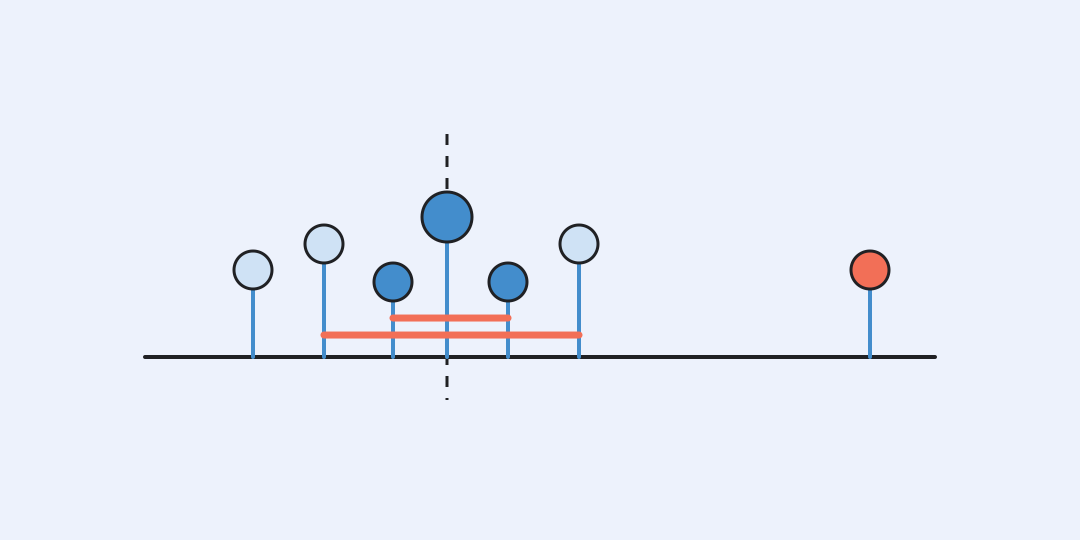
It finds the median of your numbers, measures every absolute distance from that median, and reports the median of those distances.
Two medians, one result
Enter at least one number, separating entries with spaces, line breaks or semicolons. For an even-sized list, each median is the average of its two middle sorted values. The main result is the unscaled median absolute deviation (MAD).
Here is the data median. The absolute value turns differences into distances. A second, quieter figure multiplies raw MAD by 1.4826. It estimates a scale comparable with standard deviation for roughly normal data, especially with many observations; it is not the standard deviation of this particular list. The official R documentation explains the same factor.
Check what an outlier changes
Seven values: enter 1, 1, 2, 2, 4, 6, 9. The median is 2; the sorted absolute distances are 0, 0, 1, 1, 2, 4, 7. Their median is 1, so MAD is 1 unit.
One large reading: compare 1, 2, 3, 4, 5 with 1, 2, 3, 4, 100. Both lists have median 3 and MAD 1. The distant 100 still matters, but it does not move the centre of these five values.
Even-sized list: for 2, 4, 8, 10 the median is 6. Distances 4, 2, 2, 4 have median 3, so MAD is 3. Averaging the two central distances is necessary here.
Units, rounding and a zero result
MAD keeps the unit of the input data. If the values are seconds, the answer is seconds. The 0-to-10 decimal-place control changes display only. Decimal commas work, but do not use thousands separators; write 1000 rather than 1 000.
A zero MAD does not prove that every number is equal: in 1, 1, 1, 2, 100, the median and most distances are zero. Always inspect minimum and maximum when outliers matter. The calculator accepts up to 10,000 numbers and 200,000 characters, and rejects magnitudes it cannot calculate reliably.
If you want every distance to affect the average instead, compare the mean absolute deviation calculator.
Questions worth checking
Is MAD always nonnegative?
Yes. Absolute distances are nonnegative, and their median cannot be negative.
Why is my result different from R's mad()?
R multiplies by 1.4826 by default. This page shows the unscaled MAD as the main answer and places the normal-scale estimate below it.
Can a single value be analysed?
Yes. Its median is itself, so its only distance and MAD are zero. One observation does not establish real-world stability.
Does the input order matter?
No. Both median steps sort their values; rearranging the same list leaves the answer unchanged.
Does MAD identify which value is an outlier?
No. It describes central spread. Check the original list and range before deciding that a particular observation is erroneous.
Similar calculators
You may find the following calculators on the same topic useful:
- Fraction to decimal calculator. Enter a numerator and denominator to see the decimal value; add a whole part if needed.
- Coefficient of variation calculator. Enter a list of numbers to see their relative spread as a percentage.
- Variance calculator. Paste numbers, choose a data type, and see how far the values spread around their mean.
- Percentile and percentile rank calculator. Enter numbers, then choose a percentile or compare one value with the list.
- Bayes theorem calculator. Use the event rate, signal sensitivity and false-alarm rate to update the probability after a signal.
- Sample size calculator. Choose your precision and confidence level to estimate how many usable answers to collect.
- Simple Calculator. Simply calculate whatever you need.
- Pi Calculator. Find out the value of Pi with the desired number of decimal places.
- Calculator for the Number 'e'. Calculate the desired number of decimal places in the number 'e' (Euler's number or Napier's constant) using the 'e' number calculator.
- Quadratic Equations Calculator. Apply methods to solve quadratic equations using formulas, discriminant, and Vieta's theorem.
Share on social media
If you liked it, please share the calculator on your social media platforms. It`s easy for you and beneficial for the project`s promotion. Thank you!