Contents
How the calculator finds a rate for equal distances
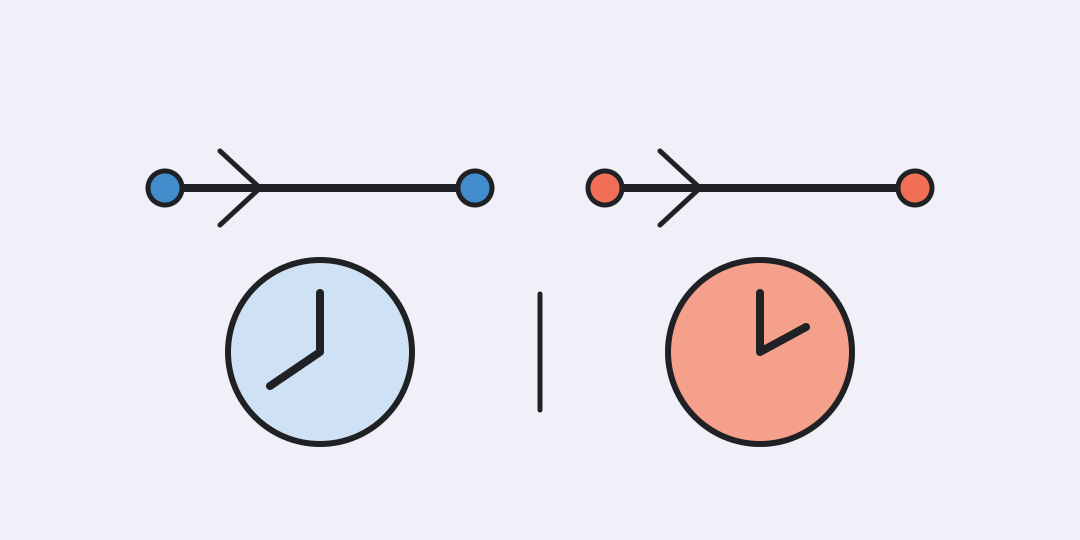
The harmonic mean gives one representative rate for positive values when each rate applies to the same distance or workload. Enter the rates as a list; the answer reflects the extra time spent at the slower rate.
The reciprocal formula
With two equally long sections driven at 30 and 60 units of distance per hour, the slower section takes twice as long. Their combined average is 40, so adding the speeds and dividing by two would answer a different question.
Here n is the number of positive observations and each x is a rate in the same unit. The calculator scales reciprocals by the smallest value to keep very small positive inputs numerically stable.
Three ways to check the answer
Equal road sections: enter 30 and 60. For two sections of 60 km, travel takes 2 hours and 1 hour. A total of 120 km in 3 hours gives 40 km/h. The arithmetic mean, 45 km/h, is too high for this trip.
Three rates: enter 2, 3 and 6. Their reciprocals add to 1, so the harmonic mean is 3. This is the equivalent rate when each input covers the same amount of work.
One repeated rate: enter 7, 7 and 7. The calculation returns 7; repeating an unchanged rate cannot alter the overall rate.
When the number needs more context
Use one unit throughout the list. If one speed is in km/h and another in m/s, convert them first; the result uses the common unit. The decimal setting affects the visible number only. Copying keeps the calculated value.
For equal travel times, use the arithmetic mean. If section lengths differ, calculate each section's time and divide total distance by total time. Zero and negative values are excluded, and an empty list has no result. The form accepts up to 10,000 numbers or 200,000 characters.
Questions about averaging rates
The same two speeds can produce different trip averages when the distances or times change.
Why is the answer closer to the slower speed?
The slow section takes more time over an equal distance, so it has more influence on total travel time.
Can I include a stop as a speed of zero?
No. Add the stop duration to total time and divide the full distance by that time instead.
What if the sections have different lengths?
Find time as distance divided by speed for each section, then divide combined distance by combined time.
Do repeated values count more than once?
Yes. Each occurrence represents another equal portion, so repeating a rate gives it more weight.
Does rounding affect the computation?
No. Decimal places change only the displayed answer; the stored result is calculated before formatting.
Similar calculators
You may find the following calculators on the same topic useful:
- Arrangements and permutations calculator. Choose how many distinct elements to arrange and get every digit of the answer.
- Improper fraction to mixed number calculator. Enter an integer numerator and positive denominator to see the whole units and simplified remainder.
- Fraction comparison calculator. Enter two integer numerators and positive denominators to compare their values.
- Prime factorization calculator. Enter a nonzero whole number to see its prime factors and their exponents.
- Expected value calculator. Enter each possible outcome and its percentage probability to find the long-run average and spread.
- Time duration calculator. Enter a start and end time to find the net duration, then add more intervals when the time is split.
- Fraction addition calculator. Enter two fractions, choose an operation and get an exact reduced answer.
- Divisors of a number calculator. Enter a positive whole number to see how many divisors it has, then open the complete list.
- Mean absolute deviation calculator. Enter numbers to see how far they lie from their arithmetic mean on average.
- Median absolute deviation calculator. Enter numbers to find the typical distance from their median.
Share on social media
If you liked it, please share the calculator on your social media platforms. It`s easy for you and beneficial for the project`s promotion. Thank you!