Contents
What mean, median and mode say about one list
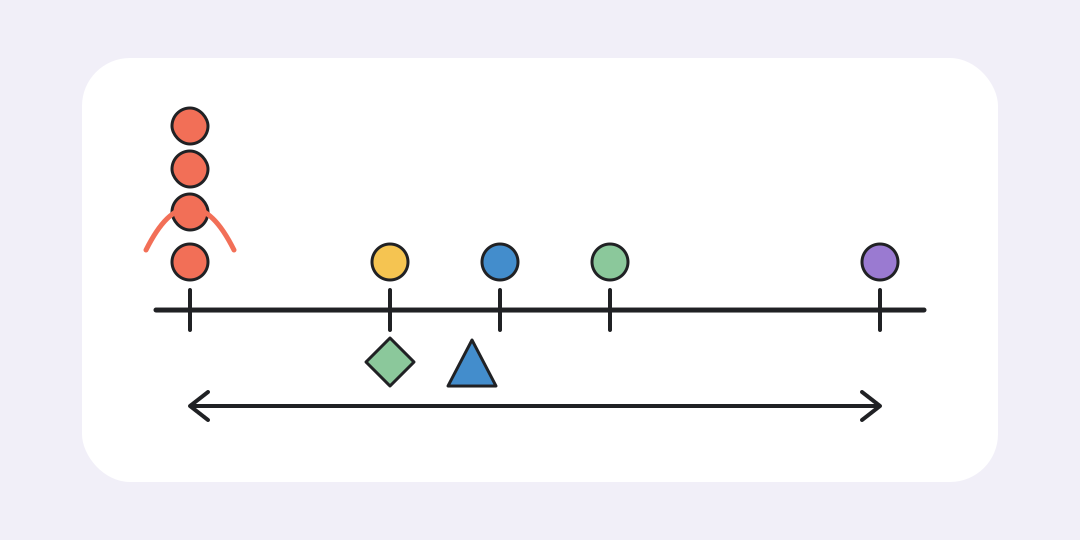
Paste a numerical list to compare three descriptions of its centre. The arithmetic mean uses every value, the median takes the middle position after sorting, and the mode identifies the most frequent value. The calculator also reports the mode frequency, range, minimum, maximum, sum and count.
These answers can differ for a good reason. A large outlier pulls the mean toward it, while the median often stays near the ordinary observations. A mode appears only when at least one exact value repeats more often than the others.
How each measure is calculated
For values, add every observation and divide by the count. The result is the arithmetic mean.
To find the median, sort the values from smallest to largest. An odd-sized list has one middle value. An even-sized list uses the mean of the two central values.
The mode is the value with the greatest frequency. If several values share that greatest frequency, the result includes all of them. If every value occurs once, this calculator reports no mode. The range uses only the two endpoints.
Worked examples reveal the differences
Completion times: 9, 10, 12, 13, 13, 13, 15, 15, 16, 16, 18, 22, 23, 24, 24 and 25 minutes. The sum is 268 across 16 observations, so the mean is 16.75. The two central values are 15 and 16, giving a median of 15.5. The mode is 13 with frequency 3, and the range is 16.
Delays of 1, 1, 2 and 2 minutes. The mean and median are both 1.5. Values 1 and 2 each occur twice, so the list has two modes with a shared frequency of 2. Its range is only 1 minute.
Books read: 1, 2 and 3. The mean and median are both 2. Every value occurs once, so there is no mode. The range is 2.
Five salaries: 40, 42, 45, 48 and 500 thousand. The mean rises to 135, while the median remains 45 and the range reaches 460. For a description of the typical salary, the median is more representative; for the total payroll per employee, the mean still has a clear use.
Choose the measure that matches the question
Use the mean when every magnitude should contribute to the answer, such as total cost per item or total study time per session. Use the median when the middle rank matters and rare extremes should not dominate, such as house prices or delivery times. Use the mode when the most common exact option is useful, such as a shoe size or a repeated test score.
The range is a quick boundary check, not a complete measure of spread. It ignores every observation except the minimum and maximum. To describe how the whole list varies around its mean, use the standard deviation calculator.
A disagreement between the mean and median is information, not a fault. It can signal a skewed list, an outlier, or a data-entry error worth checking. Do not remove a distant value automatically: first decide whether it is a mistake or a real observation.
Input, precision and limits
Separate values with spaces, new lines, semicolons or vertical bars. A comma followed by whitespace is also a separator. Decimal points and decimal commas are accepted, along with scientific notation and the Unicode minus sign. Thousands separators are not supported because they can be confused with decimals or separate observations.
The calculator accepts up to 10,000 finite values and 200,000 characters. The displayed precision can be set from 0 to 10 decimal places. This setting changes only the presentation; calculations and copied values retain the available machine precision.
Exact repetition determines the mode. Values 2 and 2.00 are the same after parsing, while 2 and 2.0001 are different. Sorting affects only the median calculation and the presentation of multiple modes; it does not change the original values.
Questions about mean, median and mode
The best summary depends on what the list represents. These answers cover the common edge cases before you interpret the result.
Which measure should I report?
Report the mean when all magnitudes and their total matter, the median when a resistant middle is more useful, and the mode when the most frequent exact value answers the practical question. Showing more than one can make a skewed list clearer.
Can a list have more than one mode?
Yes. Every value tied for the greatest frequency is a mode. The calculator lists all tied modes rather than choosing one arbitrarily.
Why does the calculator say there is no mode?
If every distinct value occurs exactly once, no value is more frequent than another. This convention reports no mode, while the mean and median remain valid.
How is the median found for an even number of values?
After sorting, take the two central values and calculate their arithmetic mean. The result does not have to be one of the original observations.
Can I enter negative and decimal values?
Yes. Negative values, decimal points, decimal commas and scientific notation are accepted. Keep every observation in the same unit.
Should I remove an outlier before calculating?
Not automatically. Check whether it is a data error or a genuine observation, then calculate the version that matches your stated data-cleaning rule. Comparing mean and median helps show its effect.
Similar calculators
You may find the following calculators on the same topic useful:
- Quartile and interquartile range calculator. Paste a number list to measure its central half and identify observations beyond the inner fences.
- Time converter. Enter a duration and convert it instantly between common short, everyday, and average calendar units.
- Geometric mean calculator. Enter positive values to find their representative multiplicative factor.
- Harmonic mean calculator. Enter positive rates or ratios to see their harmonic mean.
- Arrangements and permutations calculator. Choose how many distinct elements to arrange and get every digit of the answer.
- Improper fraction to mixed number calculator. Enter an integer numerator and positive denominator to see the whole units and simplified remainder.
- Fraction comparison calculator. Enter two integer numerators and positive denominators to compare their values.
- Prime factorization calculator. Enter a nonzero whole number to see its prime factors and their exponents.
- Expected value calculator. Enter each possible outcome and its percentage probability to find the long-run average and spread.
- Time duration calculator. Enter a start and end time to find the net duration, then add more intervals when the time is split.
Share on social media
If you liked it, please share the calculator on your social media platforms. It`s easy for you and beneficial for the project`s promotion. Thank you!