Contents
Express the same energy in another unit
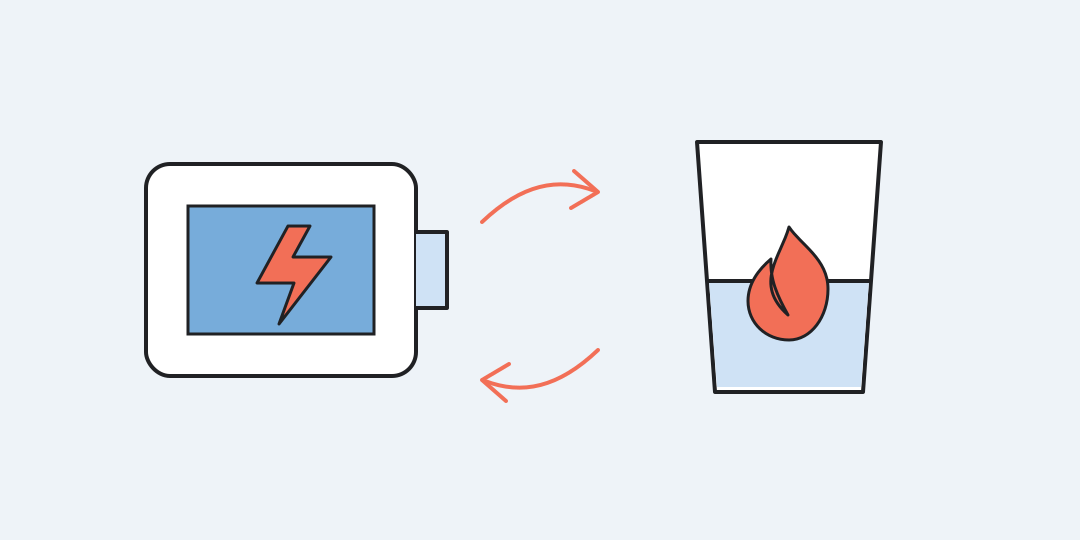
Enter energy in either field and select two units. The other field updates immediately, whether the value starts in joules, kilowatt-hours, calories, Btu, or a conventional fuel equivalent.
Every conversion passes through joules
The converter assigns each unit a factor in joules. It multiplies the source value by its factor, then divides by the target factor.
Here E is the numerical energy value and k is the number of joules in one unit. For example, 1 Wh is 3,600 J because one watt means one joule per second and one hour contains 3,600 seconds. NIST lists the standard conversion factors for units used with SI.
Useful checks across three scales
Electricity: 1 kWh equals 3.6 MJ. A 2 kW appliance running for half an hour therefore uses 1 kWh, assuming the power stays constant.
Food energy: 500 thermochemical kcal equals 2.092 MJ. The number 500 on a food-energy label normally refers to kilocalories, not 500 small calories.
Engineering comparison: 1 kg of TNT equivalent equals 4.184 MJ. This is a defined comparison unit; it does not describe the mass of an unknown explosive.
Exact factors and conventional equivalents
Metric prefixes and watt-hour relationships are exact here. The converter uses the thermochemical calorie, 4.184 J, and the International Table Btu, 1,055.05585262 J. Different historical calorie or Btu definitions produce slightly different answers, so the unit name matters.
A tonne of oil equivalent and a barrel of oil equivalent are standardized comparison quantities. Real fuel samples vary in composition and heating value. The display keeps up to 12 significant digits, but extra digits do not make an approximate fuel equivalent more certain.
Questions about energy conversion
Most mistakes come from confusing energy with power or small calories with food kilocalories.
Is a kilowatt the same as a kilowatt-hour?
No. A kilowatt measures power, while a kilowatt-hour measures energy used or delivered over time.
How many joules are in 1 kWh?
Exactly 3,600,000 J, which is also 3.6 MJ.
Does kcal mean the Calories shown on food labels?
Usually yes. One nutritional Calorie with a capital C is one kilocalorie, or 4,184 J in the thermochemical definition used here.
Can I type into the converted field?
Yes. Both fields are editable, and the last field changed becomes the source for the next conversion.
Does the converter include efficiency or heat loss?
No. It changes the unit only. Equipment efficiency and losses require a separate calculation.
Similar calculators
You may find the following calculators on the same topic useful:
- Pressure unit converter. Enter a pressure value and see the equivalent immediately in another scientific, engineering, weather, or gauge unit.
- Power unit converter. Enter a known power and see its equivalent immediately in another electrical, mechanical, or thermal unit.
- Dew point calculator. Enter air temperature, relative humidity, and a surface temperature to calculate the dew point and condensation margin.
- Battery runtime calculator. Enter battery details and average load to estimate operating time or the capacity needed for a target duration.
- Absolute humidity calculator. Enter air temperature and relative humidity to find the water vapor in one cubic meter of air.
- Hydrostatic pressure calculator. Enter depth and fluid properties to find the pressure at a point below the surface.
- Water heating time calculator. Enter the amount of water and your heater's power to estimate the wait and energy use.
- Electric Power Calculator. Calculate the electric current power in watts (W) based on current strength, voltage, and resistance online.
- Average Speed Calculator. Calculate the online average speed of a car or runner based on time and distance.
- Friction Coefficient Calculator. Calculate the coefficient of friction based on the angle of inclination or using mass and friction force.
Share on social media
If you liked it, please share the calculator on your social media platforms. It`s easy for you and beneficial for the project`s promotion. Thank you!