Contents
Read the same pressure in another unit
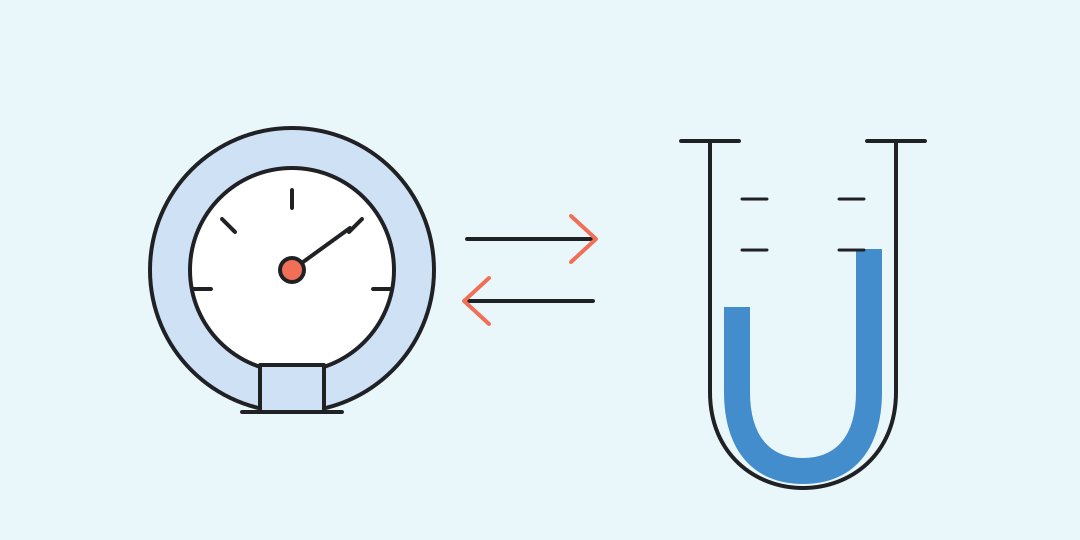
Enter a pressure in either field and select two units. The other field updates immediately, from pascals and bar to psi, atmospheres, or conventional liquid-column units.
Pascals connect all 17 units
The converter stores one factor for each unit: the number of pascals in that unit. It multiplies by the source factor and divides by the target factor.
For example, 1 bar contains 100,000 Pa and 1 kPa contains 1,000 Pa, so 1 bar equals 100 kPa. The factors follow the NIST pressure conversion table.
Checks for tyres, weather, and instruments
Tyre reading: 32 psi equals about 2.20632233381 bar. The conversion changes the unit, not the vehicle manufacturer's recommendation.
Weather report: 1,013.25 hPa equals exactly 101.325 kPa and one standard atmosphere.
Mercury column: 760 conventional mmHg equals about 101.325024 kPa. The small difference from 1 atm comes from the rounded conventional mmHg factor used here.
Unit conversion does not change the pressure reference
A gauge may report pressure above local atmospheric pressure, while an absolute sensor uses vacuum as zero. Converting 2 bar gauge to psi still gives gauge pressure; the tool does not add atmospheric pressure.
Mercury and water columns have several historical or temperature-specific definitions. This calculator labels its values conventional and uses fixed factors. Keep the original definition when a technical specification names one.
Questions about pressure units
Most mistakes come from confusing similar atmosphere symbols or losing the reference behind a measurement.
How many kilopascals are in one bar?
Exactly 100 kPa are in 1 bar.
Is 1 atm the same as 1 bar?
No. One standard atmosphere is exactly 101.325 kPa, while one bar is exactly 100 kPa.
Are atm and technical atmosphere the same?
No. Standard atmosphere, atm, is 101.325 kPa. Technical atmosphere, at, is 98.0665 kPa.
Can I convert gauge pressure to absolute pressure here?
No. The converter changes units only. You must add the relevant atmospheric pressure separately when the measurement context requires it.
Can I edit the converted field?
Yes. The last field edited becomes the source for the next conversion.
Similar calculators
You may find the following calculators on the same topic useful:
- Power unit converter. Enter a known power and see its equivalent immediately in another electrical, mechanical, or thermal unit.
- Dew point calculator. Enter air temperature, relative humidity, and a surface temperature to calculate the dew point and condensation margin.
- Battery runtime calculator. Enter battery details and average load to estimate operating time or the capacity needed for a target duration.
- Absolute humidity calculator. Enter air temperature and relative humidity to find the water vapor in one cubic meter of air.
- Hydrostatic pressure calculator. Enter depth and fluid properties to find the pressure at a point below the surface.
- Water heating time calculator. Enter the amount of water and your heater's power to estimate the wait and energy use.
- Electric Power Calculator. Calculate the electric current power in watts (W) based on current strength, voltage, and resistance online.
- Average Speed Calculator. Calculate the online average speed of a car or runner based on time and distance.
- Friction Coefficient Calculator. Calculate the coefficient of friction based on the angle of inclination or using mass and friction force.
- Ohm's Law Calculator. Calculate resistance, current, and voltage according to Ohm's Law using the known parameters.
Share on social media
If you liked it, please share the calculator on your social media platforms. It`s easy for you and beneficial for the project`s promotion. Thank you!