Contents
How the Fibonacci calculator works
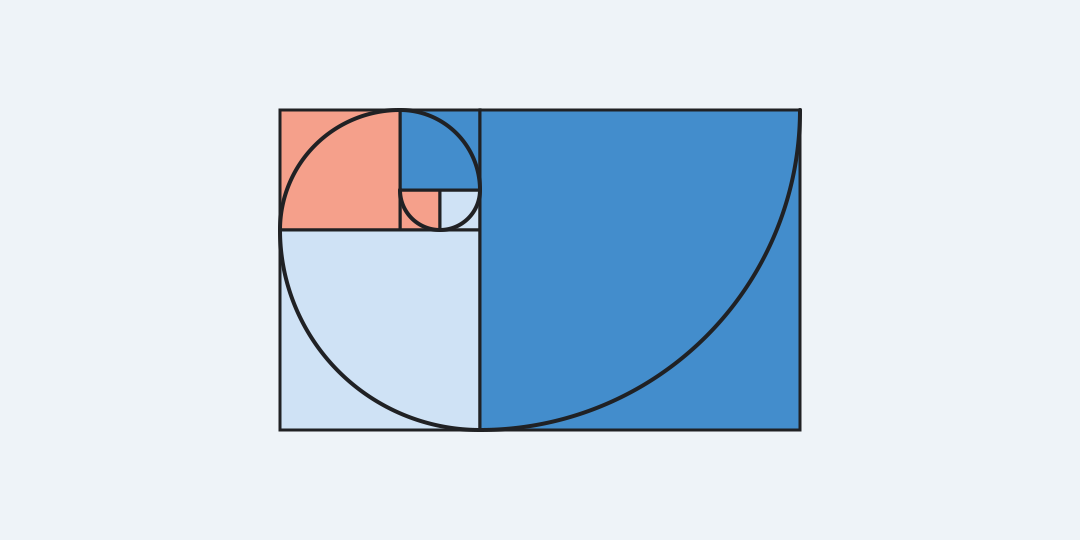
The calculator treats the sequence as and , then returns the exact term for your index together with its neighbours.
Enter a position, not a target value
The input is the index n. For example, n = 10 asks for the term at position 10 and produces 55. It does not search for where the number 10 appears.
For small indices you can follow the recurrence by hand. For large ones the page uses fast doubling, which repeatedly halves the index and keeps every operation in integer arithmetic.
Indices from 0 through 40,000 are accepted. The visible number is grouped for reading, while the copy button preserves the digits without spaces.
Three ways to check the result
Index 10. The terms around it are 34, 55, and 89. Since 34 + 55 = 89, the neighbour panel confirms the recurrence.
Index 20. The answer is 6,765. A staircase with 19 steps that allows moves of one or two steps has the same number of routes, because each final move comes from one of two earlier states.
Index 100. The exact value is 354,224,848,179,261,915,075. It has 21 digits, so ordinary floating-point arithmetic cannot safely retain every digit.
Indexing and rounding cause most disagreements
Some books print the sequence as 1, 1, 2, 3, 5 and call the first 1 the first term. This calculator follows the common zero-based convention, so always compare an answer labelled Fₙ rather than relying on the phrase “the tenth number”.
The ratio of consecutive positive terms approaches the golden ratio, but it is only a limit. Binet's formula is useful for estimates; finite floating-point precision can spoil the last digits of a large exact result.
F₄₀₀₀₀ has 8,360 digits. The limit protects the page from impractically large rendering and copying, not from a weakness in the recurrence.
Questions about Fibonacci numbers
These answers clarify the numbering and the boundaries of this exact-integer tool.
What are F₀ and F₁?
This calculator uses F₀ = 0 and F₁ = 1, so the sequence starts 0, 1, 1, 2, 3, 5.
Why are neighbouring terms shown?
They let you verify that the previous term plus the selected term equals the next one.
Can I enter a negative index?
No. The interface covers the standard non-negative sequence from 0 to 40,000.
Is the large result rounded?
No. Fast doubling and BigInt keep the result as an exact integer.
Why stop at 40,000?
The result already contains 8,360 digits, so a higher limit would mainly make displaying and copying the answer less practical.
Similar calculators
You may find the following calculators on the same topic useful:
- Double Factorial Calculator. Enter an integer to multiply numbers of the same parity from n down to 2 or 1.
- Primorial Calculator. Enter a whole-number limit to multiply every prime not greater than n.
- Superfactorial Calculator. Enter a whole number n to multiply all factorials from 1! through n!.
- Prime Number Checker. Enter a whole number to classify it as prime, composite, or an exceptional value.
- Division with remainder calculator. Enter an integer dividend and a nonzero divisor to calculate the quotient and the unique Euclidean remainder.
- Combinations calculator. Enter the total number of elements and the selection size to get the exact number of possible groups.
- Next prime number calculator. Enter a whole number up to 1,000,000,000,000 to find the first prime number that is strictly greater.
- Digital root calculator. Enter a whole number with up to 10,000 digits to reduce it to one digit and inspect the calculation.
- Greatest common divisor calculator. Enter two integers with up to 100 digits each to find their exact greatest common divisor.
- Least common multiple calculator. Enter two integers with up to 100 digits each to find their exact least common multiple.
Share on social media
If you liked it, please share the calculator on your social media platforms. It`s easy for you and beneficial for the project`s promotion. Thank you!