Contents
How the combinations calculator works
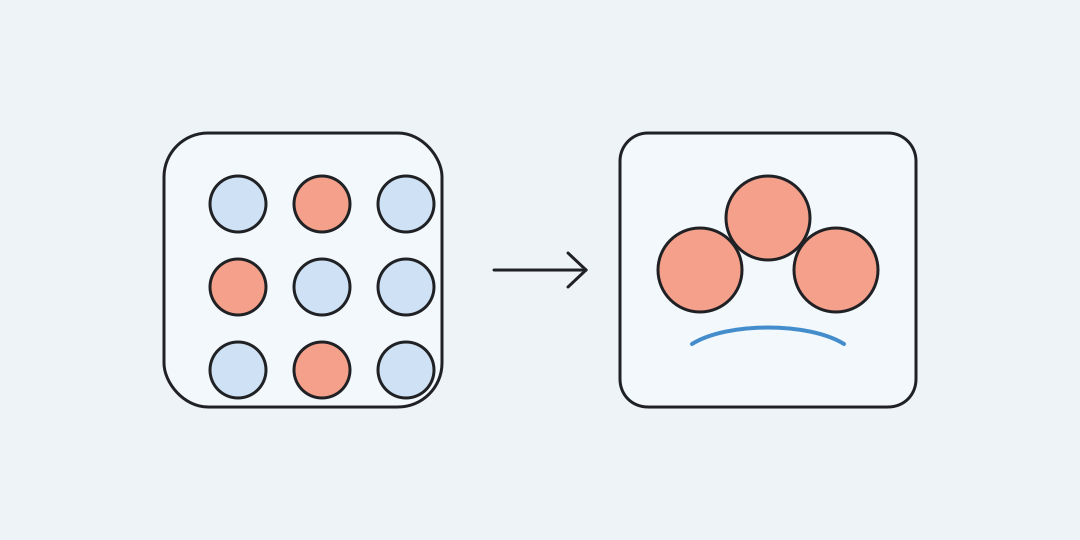
Enter the total number of distinct elements n and the number k you want to select. The calculator returns how many different groups are possible when order does not matter.
Choose this formula when order changes nothing
A group containing Ana, Ben and Chen is the same group however their names are listed. That is the key difference between a combination and an ordered arrangement.
The accepted inputs are whole numbers with 0 ≤ k ≤ n. Each element can be selected at most once.
Checks from cards, teams and menus
- C(10, 3) = 120. Ten books can form 120 different three-book selections.
- C(52, 5) = 2,598,960. This is the number of five-card hands from a standard deck.
- C(6, 2) = 15. Six toppings give 15 unordered pairs.
- C(18, 11) = 31,824. That many eleven-player groups can be chosen from 18 people before positions are assigned.
Exact integers and useful boundary cases
The calculator uses exact integer arithmetic, so a long answer is not rounded or written in scientific notation. Spaces only group the visible digits; copying returns the uninterrupted number.
C(n, 0) and C(n, n) both equal 1. Symmetry also gives C(n, k) = C(n, n - k), because choosing what stays is equivalent to choosing what is left out.
Questions about combinations
When should I use combinations instead of permutations?
Use combinations when changing the order of the selected elements does not create a new outcome.
Can k be greater than n?
No. Without repetition, you cannot select more distinct elements than the original set contains.
Why is C(n, 0) equal to 1?
There is exactly one way to choose an empty group: choose nothing.
Does the calculator allow repeated elements?
No. It calculates combinations without repetition, so each original element can appear at most once.
Are large answers rounded?
No. Every digit is calculated with exact integer arithmetic up to the accepted input limit.
Similar calculators
You may find the following calculators on the same topic useful:
- Next prime number calculator. Enter a whole number up to 1,000,000,000,000 to find the first prime number that is strictly greater.
- Digital root calculator. Enter a whole number with up to 10,000 digits to reduce it to one digit and inspect the calculation.
- Greatest common divisor calculator. Enter two integers with up to 100 digits each to find their exact greatest common divisor.
- Least common multiple calculator. Enter two integers with up to 100 digits each to find their exact least common multiple.
- Z-score calculator. Compare a value with its group mean or recover the original value from a known Z-score.
- Megabits to megabytes converter. Enter a value in Mb or MB and see the equivalent data quantity immediately.
- Standard deviation calculator. Paste a numerical list, choose population or sample, and control the displayed precision without rounding the internal result.
- Mean, median and mode calculator. Paste a list of numbers to compare its mean, median, mode, range and endpoints.
- Quartile and interquartile range calculator. Paste a number list to measure its central half and identify observations beyond the inner fences.
- Time converter. Enter a duration and convert it instantly between common short, everyday, and average calendar units.
Share on social media
If you liked it, please share the calculator on your social media platforms. It`s easy for you and beneficial for the project`s promotion. Thank you!