Contents
How the digital-root calculator works
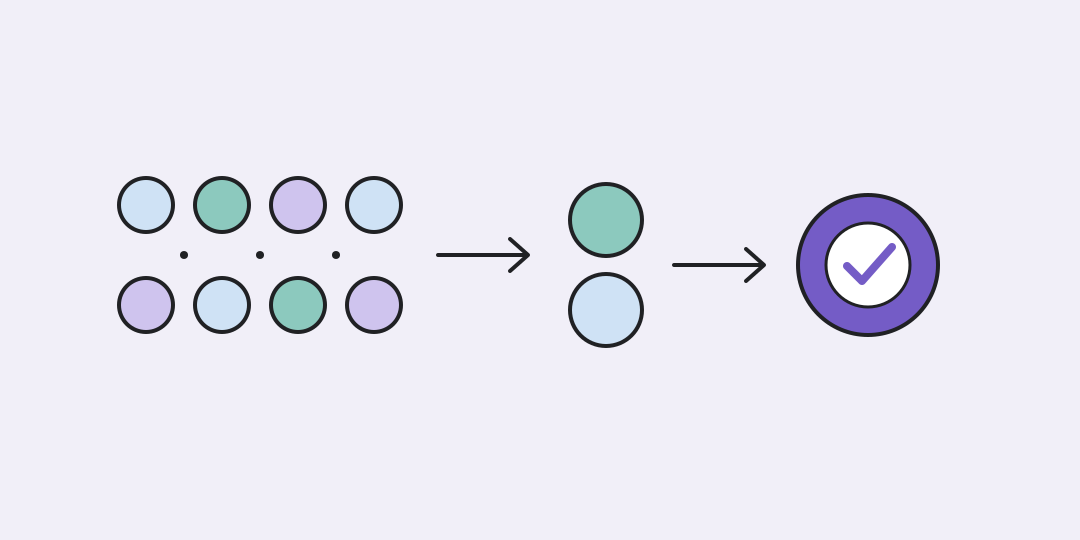
Enter a whole number. The calculator repeatedly adds its decimal digits until one digit remains, then returns that digit as the digital root.
From a long number to one digit
For 9875, the sums are 9 + 8 + 7 + 5 = 29, then 2 + 9 = 11 and finally 1 + 1 = 2. The expandable calculation shows the same chain for your input.
The formula provides a quick independent check. A nonzero multiple of 9 has digital root 9, not 0; only a number made entirely of zeroes returns 0.
- A leading plus or minus sign does not take part in the sum.
- Leading zeroes count as input digits but do not change the result.
- The answer is exact even when the input is too long for an ordinary JavaScript number.
Examples worth checking
9875 gives 2. Its chain is 9875 → 29 → 11 → 2. This is a useful test of repeated addition rather than a single pass.
999999 gives 9. Six nines total 54, and 5 + 4 = 9. The result also confirms divisibility by both 3 and 9.
-12345 gives 6. The minus sign is ignored, so the calculation begins with 1 + 2 + 3 + 4 + 5 = 15.
0000 gives 0. Leading zeroes do not turn the special zero case into a root of 9.
What the result can and cannot verify
Digital roots preserve the remainder modulo 9. That makes them useful for quick divisibility checks and the old arithmetic check sometimes called casting out nines.
Matching digital roots do not prove that a calculation is correct.
Different numbers share the same root, and rearranging digits leaves their sum unchanged. For example, 123 and 321 both have root 6. An error that changes a value by a multiple of 9 can also pass the check.
The field accepts up to 10,000 decimal digits. Spaces inside the number, decimal points, commas, exponent notation and letters are rejected.
Questions about digital roots
These answers cover the zero case, signs, divisibility and the limits of this compact checksum.
Why is the digital root of zero 0?
Zero is defined as a separate case. The rule that maps a zero remainder to 9 applies only to nonzero integers.
Does a minus sign change the result?
No. The calculator uses the digits of the absolute value, so 12345 and -12345 both have root 6.
How does the root test divisibility by 3?
A root of 3, 6 or 9 means that the original integer is divisible by 3. A root of 9 means that a nonzero integer is divisible by 9.
Can two different numbers have the same digital root?
Yes. Numbers that differ by a multiple of 9 share the same remainder pattern; 37, 46 and 100 all have root 1.
Do leading zeroes matter?
They increase the displayed digit count but contribute nothing to the sum, so 37 and 00037 have the same root.
Can I enter a decimal fraction?
No. This calculator applies the standard decimal digital-root definition to whole numbers only.
Similar calculators
You may find the following calculators on the same topic useful:
- Greatest common divisor calculator. Enter two integers with up to 100 digits each to find their exact greatest common divisor.
- Least common multiple calculator. Enter two integers with up to 100 digits each to find their exact least common multiple.
- Z-score calculator. Compare a value with its group mean or recover the original value from a known Z-score.
- Megabits to megabytes converter. Enter a value in Mb or MB and see the equivalent data quantity immediately.
- Standard deviation calculator. Paste a numerical list, choose population or sample, and control the displayed precision without rounding the internal result.
- Mean, median and mode calculator. Paste a list of numbers to compare its mean, median, mode, range and endpoints.
- Quartile and interquartile range calculator. Paste a number list to measure its central half and identify observations beyond the inner fences.
- Time converter. Enter a duration and convert it instantly between common short, everyday, and average calendar units.
- Geometric mean calculator. Enter positive values to find their representative multiplicative factor.
- Harmonic mean calculator. Enter positive rates or ratios to see their harmonic mean.
Share on social media
If you liked it, please share the calculator on your social media platforms. It`s easy for you and beneficial for the project`s promotion. Thank you!