Contents
How the superfactorial calculator works
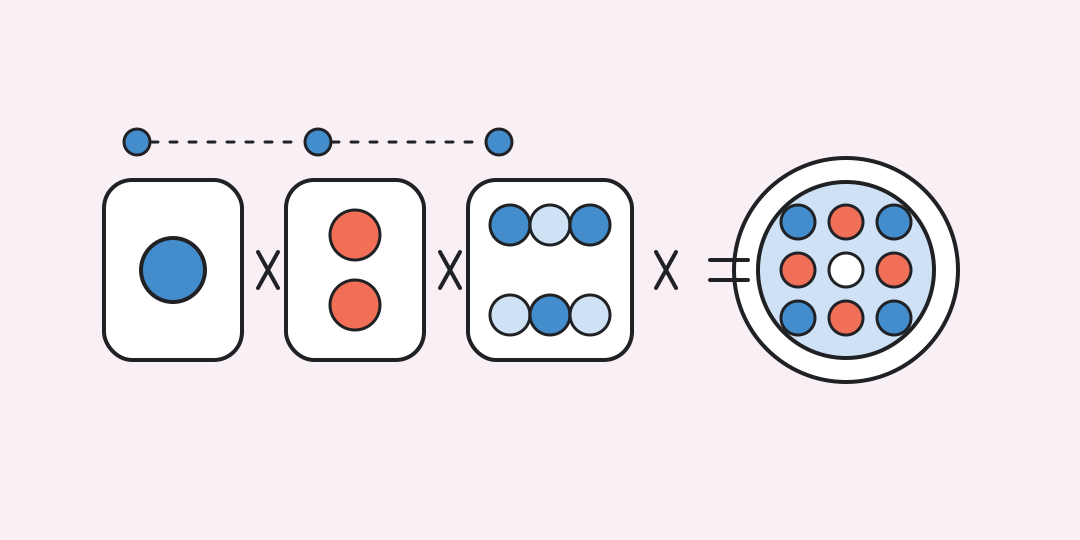
Enter a whole number n. The calculator builds 1!, 2!, and every factorial through n!, multiplies them together, and returns the exact integer sf(n).
One product contains many factorials
The definition used here is 1! × 2! × … × n!. For n = 4, the factors are 1, 2, 6, and 24, so sf(4) = 288. Open the expansion below the result to verify the symbolic chain and its last factorial.
A useful recurrence is . Dividing consecutive values should therefore return n!.
Checks from small to large
sf(3) = 12. Multiply 1! × 2! × 3! = 1 × 2 × 6.
sf(5) = 34,560. The previous value 288 receives the new factor 5! = 120.
sf(6) = 24,883,200. The ratio sf(6) / sf(5) equals 720, exactly 6!.
sf(10) has 28 digits. Its exact value is 6,658,606,584,104,736,522,240,000,000, already too large for ordinary fixed-precision integer storage.
Boundary values and similar names
sf(0) equals 1 because no factorials are selected and the empty product is defined as 1. This also makes sf(1) = sf(0) × 1! work without a special exception.
A superfactorial is not n!! and not (n!)!. Double factorial skips every other integer; a factorial of a factorial applies ! twice in sequence. Those operations produce different values.
The calculator accepts integers from 0 through 110. At the upper limit the answer has 8,632 digits. Display spaces only group a long number for reading; copying returns every digit without separators or rounding.
Questions about superfactorials
The name has been used for more than one fast-growing function, so the displayed product is the safest way to identify this definition.
What is sf(n)?
Here sf(n) is the product 1! × 2! × … × n!, including each ordinary factorial up to n!.
Why is sf(0) equal to 1?
There are no factors at n = 0. The empty product is defined as 1, preserving the recurrence from the first step.
Is a superfactorial the same as a double factorial?
No. n!! multiplies integers in steps of two, whereas sf(n) multiplies consecutive factorials.
How can I check a large result?
Divide sf(n) by sf(n − 1). The quotient must equal n!.
Are long answers rounded?
No. The calculator uses exact arbitrary-length integers and retains every digit within the input limit.
Similar calculators
You may find the following calculators on the same topic useful:
- Prime Number Checker. Enter a whole number to classify it as prime, composite, or an exceptional value.
- Division with remainder calculator. Enter an integer dividend and a nonzero divisor to calculate the quotient and the unique Euclidean remainder.
- Combinations calculator. Enter the total number of elements and the selection size to get the exact number of possible groups.
- Next prime number calculator. Enter a whole number up to 1,000,000,000,000 to find the first prime number that is strictly greater.
- Digital root calculator. Enter a whole number with up to 10,000 digits to reduce it to one digit and inspect the calculation.
- Greatest common divisor calculator. Enter two integers with up to 100 digits each to find their exact greatest common divisor.
- Least common multiple calculator. Enter two integers with up to 100 digits each to find their exact least common multiple.
- Z-score calculator. Compare a value with its group mean or recover the original value from a known Z-score.
- Megabits to megabytes converter. Enter a value in Mb or MB and see the equivalent data quantity immediately.
- Standard deviation calculator. Paste a numerical list, choose population or sample, and control the displayed precision without rounding the internal result.
Share on social media
If you liked it, please share the calculator on your social media platforms. It`s easy for you and beneficial for the project`s promotion. Thank you!