Contents
How the remainder calculator works
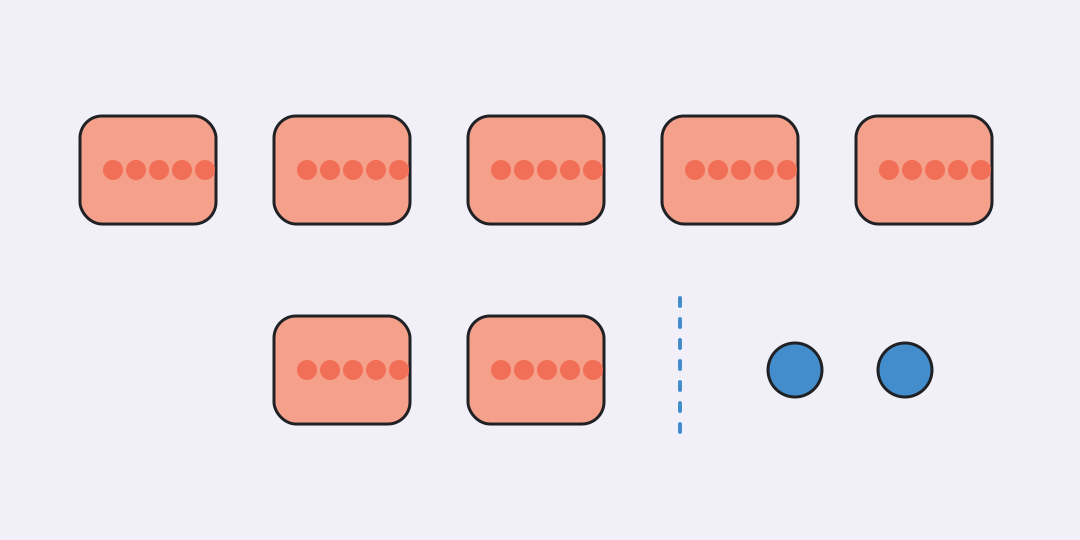
Enter an integer dividend and a nonzero integer divisor. The calculator returns the whole-number quotient and the only non-negative remainder smaller than the absolute value of the divisor.
The rule behind the answer
Euclidean division rewrites the dividend as a multiple of the divisor plus a leftover part. The pair is valid only when both the equality and the remainder range hold.
Here a is the dividend, b the divisor, q the integer quotient and r the remainder. The check printed with an ordinary result substitutes all four values into the equality.
Three ways to read a remainder
37 divided by 5 gives 7 remainder 2. Seven full groups use 35 items, leaving two: 37 = 5 × 7 + 2.
20 divided by 4 gives 5 remainder 0. A zero remainder says that 4 divides 20 exactly.
1,439 divided by 4 gives 359 remainder 3. Four lots of 359 account for 1,436, and the last three restore the dividend.
−17 divided by 5 gives −4 remainder 3. The quotient moves down to the next integer so that the remainder stays non-negative.
Input limits and negative numbers
- Both inputs must be integers; decimals do not have an integer Euclidean remainder in this tool.
- Each value may contain up to 100 digits, excluding its sign, and is calculated exactly without rounding.
- The dividend may be zero or negative. The divisor may be negative, but never zero.
Some programming languages define the % operator by truncating toward zero. For example, JavaScript reports −17 % 5 as −2. This calculator normalizes the result to the Euclidean remainder 3, so always check which convention a programming task expects.
Questions about division with a remainder
The equality is a quick check, while the range condition settles the less obvious cases involving zero and negative values.
How do I check the result?
Multiply the divisor by the quotient and add the remainder. The total must equal the dividend, and the remainder must satisfy 0 ≤ r < |b|.
Can the remainder equal the divisor?
No. If the remainder reaches the absolute value of the divisor, one more whole group can be moved into the quotient.
What does remainder zero mean?
It means the dividend is exactly divisible by the divisor. For example, 20 = 4 × 5 + 0.
Can I divide zero?
Yes. Zero divided by any nonzero integer has quotient 0 and remainder 0.
Why is division by zero rejected?
There is no remainder range below |0|, and multiplying zero by a quotient cannot determine a unique division result.
Why can a negative dividend have a positive remainder?
The quotient is chosen so that the remainder lies from 0 through |b| − 1. Thus −17 = 5 × (−4) + 3.
Similar calculators
You may find the following calculators on the same topic useful:
- Combinations calculator. Enter the total number of elements and the selection size to get the exact number of possible groups.
- Next prime number calculator. Enter a whole number up to 1,000,000,000,000 to find the first prime number that is strictly greater.
- Digital root calculator. Enter a whole number with up to 10,000 digits to reduce it to one digit and inspect the calculation.
- Greatest common divisor calculator. Enter two integers with up to 100 digits each to find their exact greatest common divisor.
- Least common multiple calculator. Enter two integers with up to 100 digits each to find their exact least common multiple.
- Z-score calculator. Compare a value with its group mean or recover the original value from a known Z-score.
- Megabits to megabytes converter. Enter a value in Mb or MB and see the equivalent data quantity immediately.
- Standard deviation calculator. Paste a numerical list, choose population or sample, and control the displayed precision without rounding the internal result.
- Mean, median and mode calculator. Paste a list of numbers to compare its mean, median, mode, range and endpoints.
- Quartile and interquartile range calculator. Paste a number list to measure its central half and identify observations beyond the inner fences.
Share on social media
If you liked it, please share the calculator on your social media platforms. It`s easy for you and beneficial for the project`s promotion. Thank you!