Contents
How the degrees to radians converter works
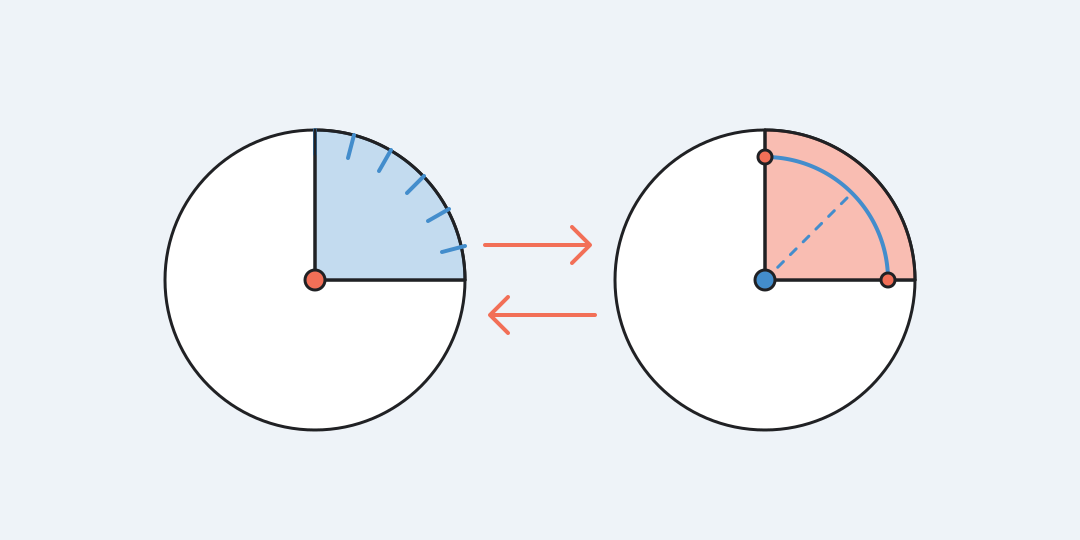
Enter an angle in either field and the converter updates the other one immediately. You can also switch to arcminutes, arcseconds or gradians without retyping the value.
Why the formula contains π
A full turn is 360 degrees and also 2π radians. Dividing both measures by two gives the conversion rule:
For the reverse direction, multiply radians by 180 and divide by π. The calculator keeps full precision during the conversion and rounds only the displayed decimal to at most ten places.
Useful angles to recognise
30° becomes 0.5235987756 rad. Its exact form is π/6, one twelfth of a complete turn.
90° becomes 1.5707963268 rad. This is π/2, the quarter-turn used for a right angle.
180° becomes 3.1415926536 rad. The decimal is an approximation of π and represents a half-turn.
7 rad becomes 401.0704565916°. The result exceeds one turn, which is valid when an angle records accumulated rotation.
Negative angles and turns larger than 360°
The conversion changes the unit, not the angle. A negative sign stays negative, so -90° becomes about -1.5707963268 rad. The sign can describe direction, but the converter does not decide whether positive means clockwise or counter-clockwise.
Angles are not reduced to a single turn. For example, 450° is shown as 7.853981634 rad rather than being replaced by 90°. Arcminutes and arcseconds are angular subdivisions, not units of time: one degree contains 60 arcminutes and 3,600 arcseconds.
Questions about degrees and radians
These short answers cover the relationships that are easiest to mix up.
How many radians are in 180 degrees?
Exactly π radians, shown as approximately 3.1415926536 in decimal form.
How many degrees are in one radian?
One radian is approximately 57.2957795131 degrees.
Can a radian value be greater than 2π?
Yes. It represents more than one complete turn, and the converter preserves it.
Are arcminutes the same as minutes of time?
No. An arcminute is an angular unit equal to 1/60 of a degree.
Why does the decimal result not end?
Most conversions involve π, an irrational number, so the displayed value must be rounded.
Similar calculators
You may find the following calculators on the same topic useful:
- Yards to metres converter. Enter a length in yards or metres and see the equivalent value immediately in the other field.
- Feet to centimetres converter. Enter a length in feet or centimetres and see the equivalent value immediately in the other field.
- Area unit converter. Enter a known area in either field and choose the units to see the equivalent value instantly.
- Kilometres to miles converter. Enter a distance in kilometres or miles and see the equivalent value immediately in the other field.
- Metres to feet converter. Enter a length in metres or feet and see the equivalent value immediately in the other field.
- Feet to inches converter. Enter a length in feet or inches and see the equivalent value immediately in the other field.
- Acres to square metres converter. Enter an area in acres or square metres and see the exact equivalent immediately.
- Oil barrels to liters converter. Enter a volume in oil barrels or liters and see the exact equivalent immediately.
- Square feet to square metres converter. Enter an area in square feet or square metres and see the equivalent value immediately.
- Nautical miles to miles converter. Enter a distance in nautical or statute miles and see the equivalent value immediately.
Share on social media
If you liked it, please share the calculator on your social media platforms. It`s easy for you and beneficial for the project`s promotion. Thank you!