Contents
How the acceleration converter works
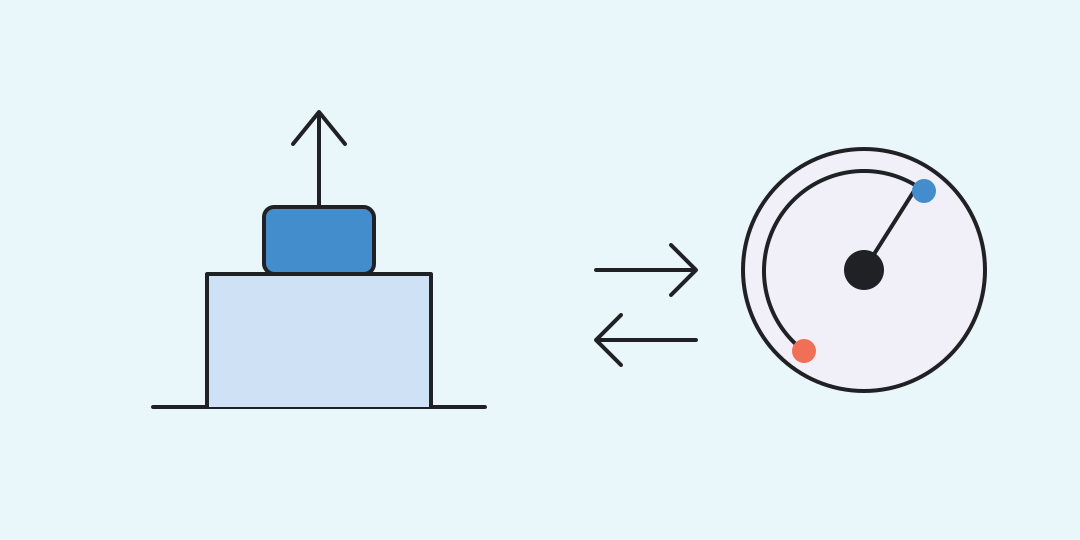
Enter an acceleration in m/s² or as a multiple of standard gravity g. The paired field updates immediately, and the middle control reverses the conversion.
Use the agreed reference, not a local measurement
For unit conversion, one g is defined as exactly 9.80665 m/s². Divide an acceleration in m/s² by that number to express it in g; multiply a value in g by the same number for the reverse direction.
Here a is acceleration in m/s² and Ng is its multiple of standard gravity. This reference keeps specifications comparable even though local gravitational acceleration varies slightly by place.
Three quick scale checks
- 4.903325 m/s² = 0.5 g. The acceleration is half the standard reference.
- 19.6133 m/s² = 2 g. Doubling the reference doubles the g value.
- 2.5 g = 24.516625 m/s². Multiply 2.5 by 9.80665 for an SI value.
- 20 m/s² ≈ 2.039432 g. Rounding to about 2.04 g is usually clearer when the source has only two significant digits.
What a g value leaves out
This conversion changes the unit, not the physical situation. A scalar value does not describe direction, duration, the axis reported by a sensor or the load felt by a person or structure.
Lowercase g in this calculator is a multiple of standard acceleration. It is not the symbol for gram, which measures mass. The converter also cannot make a rounded sensor reading more precise, even though it can display extra decimal places.
Questions about m/s² and g
The main traps are the fixed reference, the meaning of g and the precision of the source value.
How many g is 1 m/s²?
One metre per second squared is approximately 0.101971621298 g.
How many m/s² is 1 g?
Exactly 9.80665 m/s² for this standard unit conversion.
Does g mean grams here?
No. Here g expresses acceleration relative to standard gravity; gram is a unit of mass.
Why can local gravity differ from 1 g?
The conversion uses an agreed reference value. Actual gravitational acceleration varies slightly with latitude, altitude and local geology.
Can I convert a negative acceleration?
The formula works with signed components, but this interface is intended for non-negative magnitudes. Keep direction or axis information separately.
Similar calculators
You may find the following calculators on the same topic useful:
- Hectopascals to pascals converter. Enter pressure in hPa or Pa to see the equivalent value instantly and switch the conversion direction when needed.
- Calories to joules converter. Enter energy in cal or J to see the equivalent value instantly, using the small thermochemical calorie rather than the food kilocalorie.
- Joules to kilojoules converter. Enter energy in J or kJ to see the equivalent value instantly and switch the conversion direction when needed.
- Weeks to days converter. Enter a duration in weeks or days and see the equivalent value immediately.
- Years to months converter. Enter a duration in years or months and see the equivalent value immediately.
- Minutes to days converter. Enter a duration in minutes or days and see the equivalent value immediately.
- Battery charge time calculator. Enter battery capacity, charging current or power, start and target levels, and average efficiency to estimate the charging duration.
- Mass converter. Enter a mass and convert it between common metric and imperial units in either direction.
- Energy unit converter. Enter an energy quantity and see its equivalent immediately in another scientific, electrical, heat, or fuel unit.
- Pressure unit converter. Enter a pressure value and see the equivalent immediately in another scientific, engineering, weather, or gauge unit.
Share on social media
If you liked it, please share the calculator on your social media platforms. It`s easy for you and beneficial for the project`s promotion. Thank you!